Helping Australian Trade Business Owners Build More Profitable, Scalable Businesses

Stop Working Harder. Start Building a Trade Business That Can Grow Without Depending on You.


Most trade businesses don’t fail because the owner lacks technical ability.

They become stuck because the business eventually grows beyond the systems that were originally put in place.

When you’re working alone or with one apprentice, it’s possible to keep everything in your head. You know every customer, every quote, every invoice and every job because you’re involved in all of them.

As your team grows to five, ten or twenty people, that approach stops working.

The same habits that helped you survive in the early years begin limiting future growth.

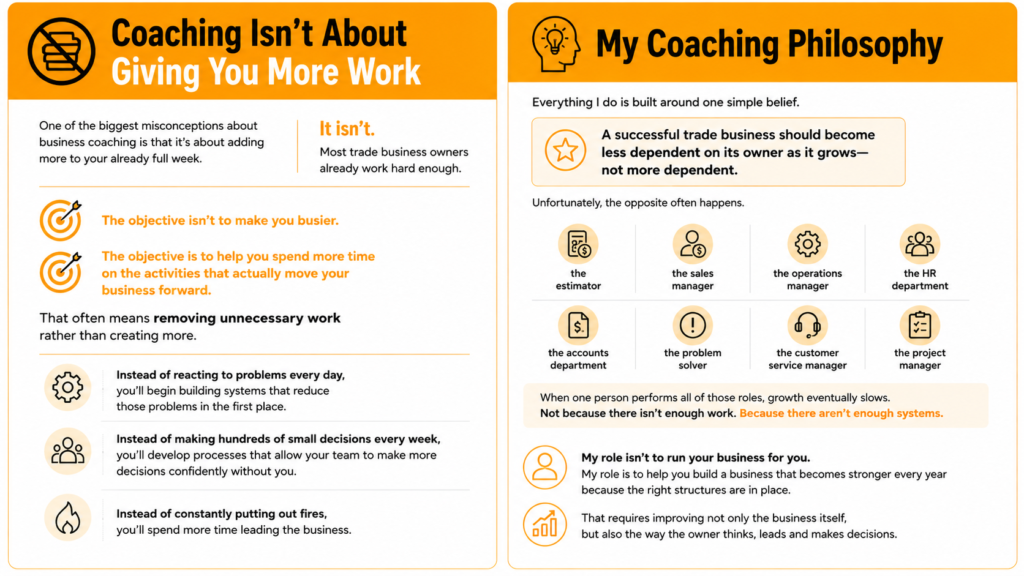
Instead of becoming the leader of the business, you become the busiest employee.

You’re still approving quotes.

You’re still answering every phone call.

You’re still solving every problem.

You’re still making every important decision.

You’re still the one everyone comes to before anything moves forward.

Eventually, you become the biggest bottleneck in your own business.

The Owner Bottleneck

One of the most common conversations I have with new clients sounds something like this:
“The business is busier than ever, but I don’t seem to have any more money.”
Or:
“I’ve got a great team, but I can’t leave them alone for more than a day.”
Or:
“I’m working more hours now than I did when I started.”

Those statements aren’t isolated problems.
They’re symptoms of the same underlying issue.
The business has grown.
The owner hasn’t changed roles.
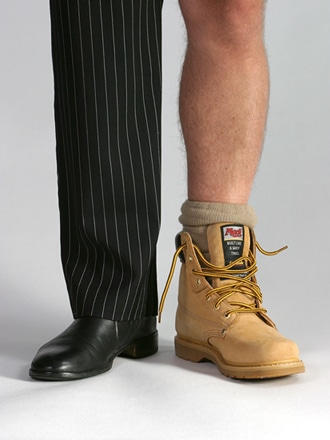
Instead of transitioning from tradesperson to business owner, many tradies continue operating as the chief technician while trying to manage a growing company around them.

That creates pressure everywhere:
→ Jobs become harder to schedule.
→ Cashflow becomes unpredictable.
→ Quotes take too long.
→ Team members stop making decisions.
→ Customers experience inconsistent service.
→ Owners work longer hours.
→ Families see less of them.
→ Profit often disappears despite record turnover.

Working harder rarely fixes these problems.
It usually makes them worse.

The Turning Point

The businesses that make the biggest leap don’t simply become busier.
They become better organised.

They introduce:
→ Clear financial reporting.
→ Better pricing systems.
→ Consistent quoting.
→ Leadership accountability.
→ Documented processes.
→ Team ownership.
→ Performance measurement.
→ Strong communication.
→ Better planning.
→ Better decision-making.

The result isn’t just more revenue.
It’s a business that becomes easier to run.
Owners regain control of their time.
Teams become more confident.
Profit improves.
Customers receive a more consistent experience.
Growth becomes sustainable rather than chaotic.
That transformation doesn’t happen through motivation alone.
It happens through structure.

Why I Chose to Specialise in Trades Businesses

After spending more than three decades working in construction, I realised something that has shaped the way I’ve coached ever since.
Tradespeople are incredibly good at learning their trade.
Electricians become excellent electricians.
Builders become excellent builders.
Plumbers become excellent plumbers.
But almost nobody teaches them how to build profitable businesses.

The skills required to install a switchboard, renovate a bathroom or build a custom home are completely
different from the skills required to:
→ manage cashflow,
→ recruit great people,
→ improve profitability,
→ build leadership,
→ create systems,
→ understand financial reports,
→ price for sustainable profit,
→ develop supervisors,
→ delegate effectively,
→ or eventually step away from the day-to-day running of the business.

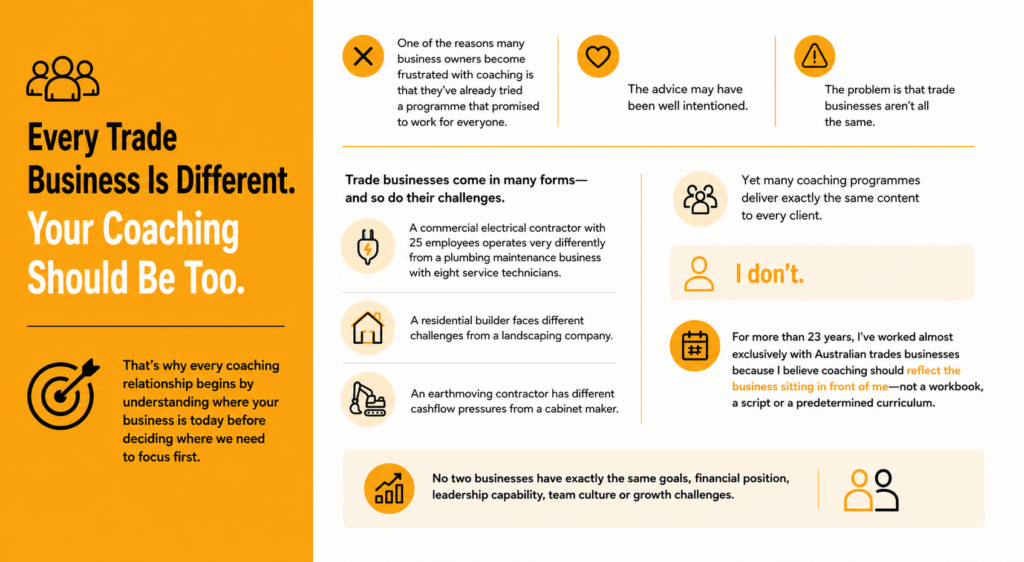
For more than 23 years, I’ve focused on helping Australian trade business owners develop those skills through practical, one-on-one coaching tailored specifically to the realities of running a trades business.
There are no generic business theories.
No cookie-cutter programs.
No one-size-fits-all templates.
Every coaching relationship is built around your business, your team, your goals and the challenges you’re facing right now.
Because while every trade business is different, the obstacles that prevent growth are often surprisingly similar.
Once you understand where those obstacles are—and put the right systems in place—you create the conditions for long-term, sustainable growth.

Who We Help

BusinessSight works with established Australian trade businesses that are ready to move beyond simply staying busy and start building a business that delivers stronger profit, better systems and greater freedom.

Typical clients include:
→ Commercial electricians
→ Residential electricians
→ Plumbing businesses
→ Commercial builders
→ Residential builders
→ HVAC contractors
→ Landscapers
→ Painters
→ Roofers
→ Cabinet makers
→ Carpenters
→ Earthmoving contractors
→ Concreters
→ Property maintenance businesses
→ Multi-trade service businesses

Most clients have between 4 and 30+ staff, although we also work with larger trade businesses looking to strengthen leadership, improve profitability or prepare for their next stage of growth.

If you’re finding that every important decision still comes through you, coaching can help you build the systems, leadership and accountability needed for your business to grow with greater confidence.

View Client Results


The Biggest Challenges Facing Trade Businesses

After working with Australian trades businesses for more than two decades, I’ve found that most growth problems fall into several key areas.
Cashflow is one of the most common reasons trade business owners seek coaching.
Many businesses appear busy.
The diary is full.
The phone keeps ringing.
The team is working overtime.
Yet there never seems to be enough money in the bank.
That usually isn’t because there’s no work.
It’s because cash is being trapped throughout the business.
Common causes include:
Under-priced work
Slow invoicing
Late debtor payments
Poor project forecasting
Excess stock
Weak purchasing controls
Too much work in progress
Large GST and BAS liabilities
Unexpected warranty costs
Low profit margins
Many owners mistakenly believe they have a sales problem.
In reality, they have a cashflow management problem.
One of the first priorities in coaching is understanding exactly where cash is entering—and leaving—the business.

Pricing is far more complex than simply charging more.
Many trade businesses estimate jobs using experience rather than reliable financial data.
That often leads to:
inconsistent margins
discounted quotes
forgotten labour
underestimated supervision
missing overhead recovery
poor subcontractor allowances
low contingency
The result?
The business stays busy but profit remains disappointing.
During coaching we examine:
Gross Profit
Net Profit
Labour recovery
Mark-up
Margin
Overhead recovery
Break-even point
Average invoice value
Revenue per employee
Revenue per productive hour
When owners understand these numbers, quoting becomes significantly more consistent.

Many owners judge productivity by whether everyone looks busy.
Unfortunately, being busy isn’t the same as being productive.
One tradesperson may spend eight hours onsite while only generating five hours of billable value.
Across an entire workforce, those small losses quickly become significant.
Improving labour utilisation often involves reviewing:
travel time
scheduling
material collection
rework
callbacks
downtime
communication
supervision
job preparation
equipment availability
Even modest improvements can have a substantial effect on profitability without increasing prices.


Labour Utilisation
Labour utilisation measures how much of your team’s available time is spent completing productive, revenue-generating work rather than travelling, waiting, fixing mistakes or performing non-billable activities.
Higher utilisation generally improves profitability without increasing workforce numbers

Every quote represents a business decision.
A poorly prepared estimate can affect profit for months.
Many growing businesses struggle because quoting depends almost entirely on the owner.
This creates two problems.
First, quoting becomes a bottleneck.
Second, estimating knowledge remains locked inside one person’s head.
Strong businesses build estimating systems that become repeatable.
That includes:
documented estimating procedures
pricing templates
supplier databases
standard labour allowances
consistent mark-ups
variation processes
approval workflows
These systems improve both speed and accuracy.

Scheduling is often underestimated.
Most owners assume it’s an administration task.
In reality, scheduling affects nearly every part of the business.
Poor scheduling can result in:
frustrated customers
idle employees
overtime
missed deadlines
excessive travel
material shortages
unnecessary callbacks
supervisor overload
As businesses grow, scheduling becomes a strategic management function rather than simply filling in a calendar.

Employing apprentices is one of the best long-term investments a trade business can make.
It can also become one of the biggest frustrations if there are no systems.
Successful businesses don’t simply employ apprentices.
They develop future leaders.
That means providing:
structured onboarding
clear expectations
regular mentoring
documented procedures
performance reviews
technical development
leadership opportunities
accountability
The goal isn’t simply producing qualified tradespeople.
It’s developing future supervisors and managers who strengthen the business.

Many trade businesses rely heavily on subcontractors.
When managed well, subcontractors provide flexibility.
When managed poorly, they create inconsistency.
Strong subcontractor management includes:
documented expectations
quality standards
communication processes
payment procedures
safety requirements
customer service expectations
reporting systems
accountability
Customers rarely distinguish between employees and subcontractors.
They judge the business as a whole.

One of the biggest changes owners experience is moving from doing the work to leading people.
This transition is rarely straightforward.
Many owners continue solving every problem because it’s faster.
Eventually, their team stops solving problems independently.
Leadership becomes reactive rather than proactive.
Effective leadership involves:
setting expectations
coaching rather than directing
developing supervisors
creating accountability
making better decisions
building trust
handling difficult conversations
recognising performance
Businesses grow when leadership grows.


Common Mistake
Many owners believe they need better employees.
Often, what they actually need are stronger leadership systems.

Culture isn’t created by motivational posters or annual Christmas parties.
Culture is shaped by what leaders consistently accept, reward and reinforce.
Healthy trade businesses typically share common characteristics:
people arrive on time
standards are clear
communication is respectful
safety matters
customers are valued
accountability exists
problems are addressed early
success is recognised
Culture directly affects:
staff retention
customer satisfaction
profitability
recruitment
productivity
Strong culture rarely happens by accident.

Every growing business eventually reaches the point where memory no longer scales.
Owners can no longer remember every customer, every process or every decision.
Systems replace memory.
Good systems create consistency.
Examples include:
onboarding
quoting
invoicing
purchasing
scheduling
customer communication
site management
quality assurance
recruitment
safety
training
The goal isn’t creating bureaucracy.
It’s reducing unnecessary decisions.
When systems improve, businesses become easier to manage and easier to grow.

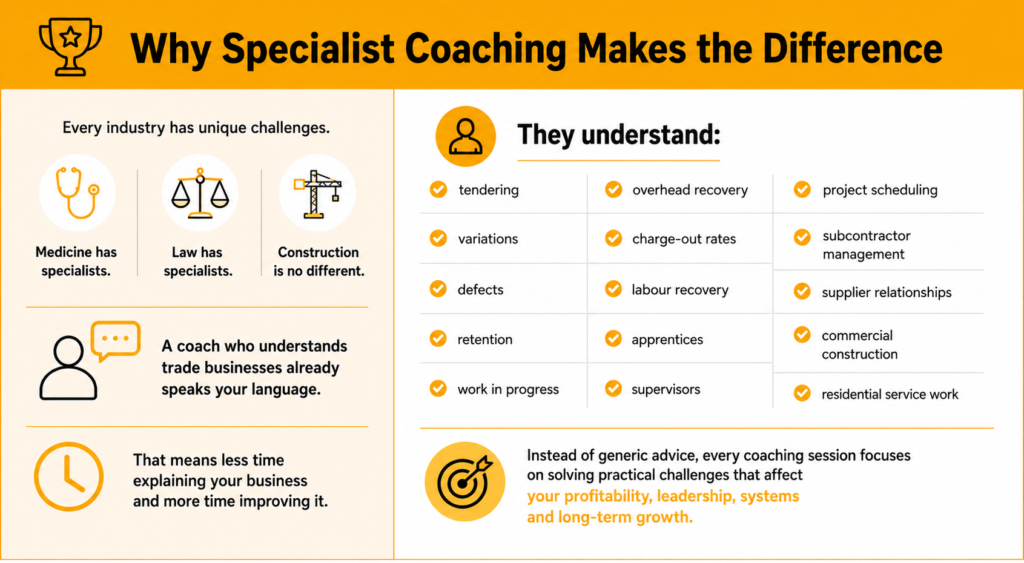
Why Specialist Coaching Makes the Difference
Every industry has unique challenges.
Medicine has specialists.
Law has specialists.
Construction is no different.
A coach who understands trade businesses already speaks your language.
They understand:
tendering
variations
defects
retention
work in progress
overhead recovery
charge-out rates
labour recovery
apprentices
supervisors
project scheduling
subcontractor management
supplier relationships
commercial construction
residential service work
That means less time explaining your business and more time improving it.
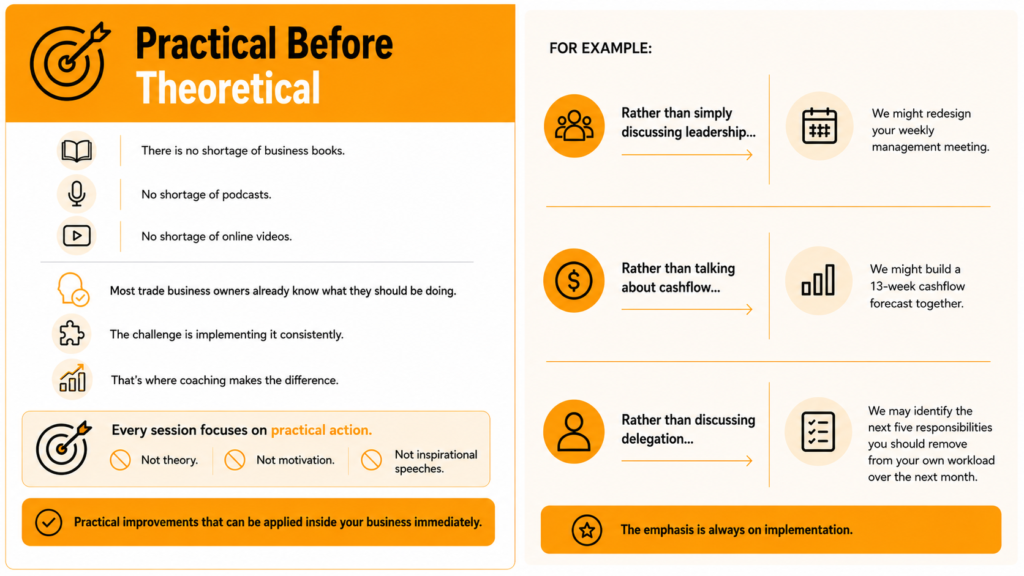
Instead of generic advice, every coaching session focuses on solving practical challenges that affect your profitability, leadership, systems and long-term growth.

Chat GPT Image Jul 10, 2026, AM

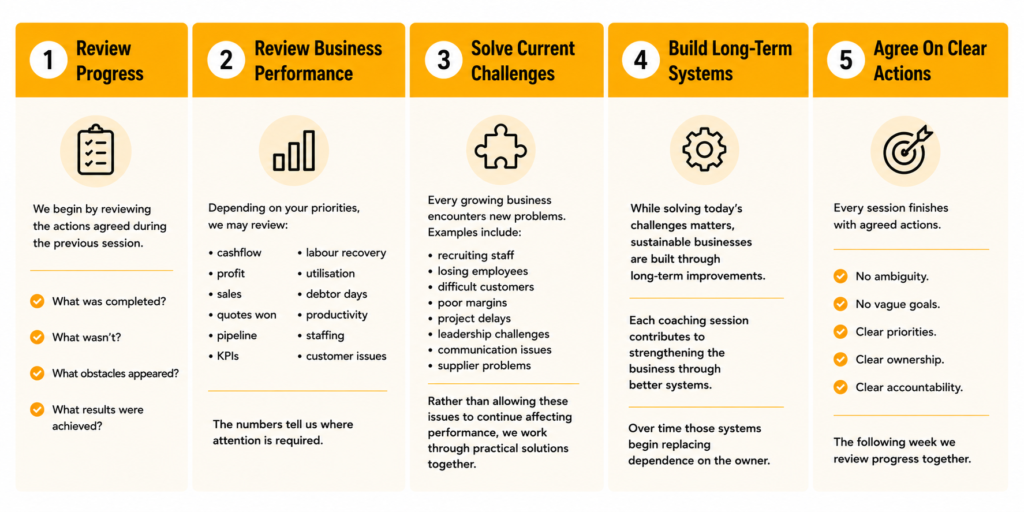
Although every business is different, most sessions follow a similar structure.
Chat GPT Image Jul 10, 2026, AM

Accountability is often misunderstood.
It isn’t about someone checking whether you’ve done your homework.
It’s about creating consistent progress.
Business owners are accountable to:
customers.
employees.
suppliers.
banks.
family.
Yet very few people are holding the owner accountable.
Coaching provides that missing layer.
Knowing someone will ask about last week’s priorities often makes the difference between talking about improvement and actually achieving it.
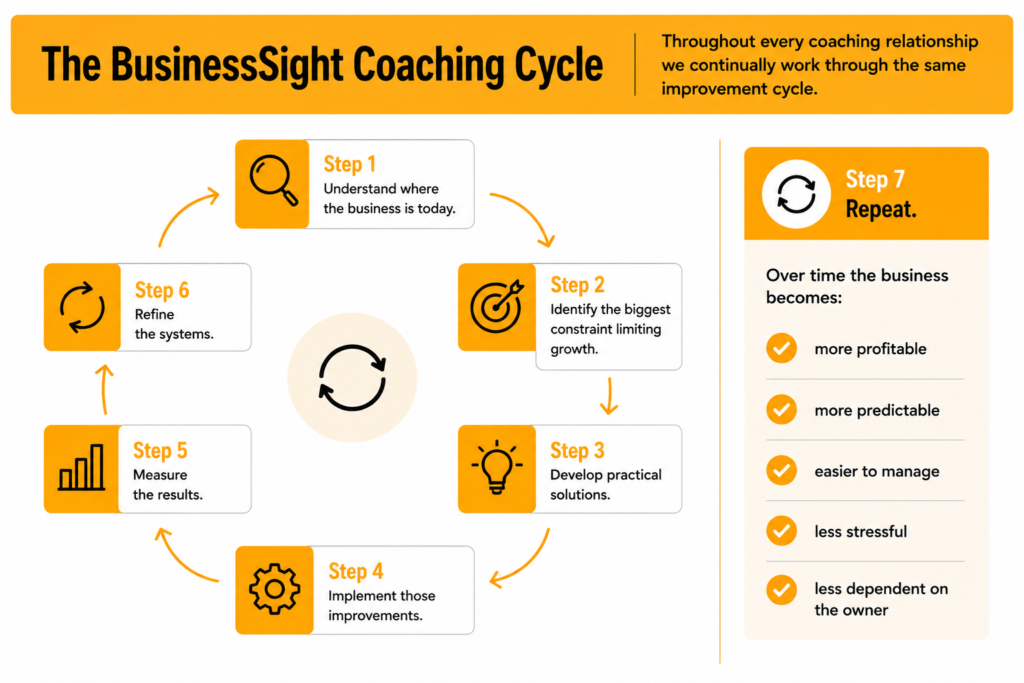
The BusinessSight Coaching Cycle
Throughout every coaching relationship we continually work through the same improvement cycle.
Step 1
Understand where the business is today.

Step 2
Identify the biggest constraint limiting growth.

Step 3
Develop practical solutions.

Step 4
Implement those improvements.

Step 5
Measure the results.

Step 6
Refine the systems.

Step 7
Repeat.
Over time the business becomes:
more profitable
more predictable
easier to manage
less stressful
less dependent on the owner

Different businesses require different priorities.
A business with five employees shouldn’t necessarily be focusing on the same issues as one with thirty employees.
During coaching we adapt our priorities according to your stage of growth.

Business StagePrimary Focus
4–8 staffCashflow, pricing, leadership foundations, basic systems
8–15 staffSupervisors, delegation, recruitment, KPIs, accountability
15–30 staffManagement structure, financial reporting, scalability, culture
30+ staffExecutive leadership, succession, growth strategy, exit planning


The coaching evolves as your business evolves.


One of my goals is that you become a better business owner—not someone who becomes dependent on having a coach forever.

The strongest coaching relationships are those where clients gradually become more confident making decisions because they understand the principles behind them.

Instead of asking:
“What should I do?”

They begin asking:
“Here’s the direction I’m thinking. What do you think?”

That’s a significant shift.
It demonstrates growth in leadership, confidence and decision-making.

  • wait too long before hiring leaders
  • promote great tradespeople without leadership training
  • focus on turnover instead of profit
  • rely on memory instead of systems
  • delay difficult conversations
  • under-price work to stay busy
  • avoid reviewing financial reports
  • fail to build cash reserves
  • keep too many responsibilities themselves
  • work harder instead of improving the business

Ready to build a business that doesn’t depend on you?


Growing a successful trade business isn’t about fixing one problem.

It’s about building every part of the business so that each area supports the others.

One of the biggest mistakes I see is owners trying to solve symptoms instead of causes.

For example:

  • Cashflow problems are often blamed on slow-paying customers, when the real issue is low margins, poor invoicing or weak working capital.
  • Recruitment problems are often blamed on a lack of good tradespeople, when the real issue is leadership, culture or systems.
  • Long working hours are often blamed on staff shortages, when the real issue is owner dependency and poor delegation.

During coaching, we don’t chase symptoms.

We identify the constraint that’s having the greatest impact on your business and address it systematically.

While every coaching relationship is tailored, most businesses improve across the following core areas.


If you can’t clearly explain where your profit comes from—or where it’s disappearing—you don’t have control of your business.

One of the first things we work on is helping you understand the numbers that drive your decisions.

Not because I want you to become an accountant.

Because every important decision you make has a financial consequence.

Should you employ another tradesperson?

Can you afford a supervisor?

Is your pricing high enough?

Can you invest in another vehicle?

Should you buy equipment or lease it?

Can the business comfortably support your wage?

Without accurate financial information, those decisions become guesswork.

Together we work on:

  • Gross Profit
  • Net Profit
  • Cashflow
  • Working Capital
  • Break-even analysis
  • Revenue per employee
  • Labour recovery
  • Wages percentage
  • Overhead recovery
  • Job profitability
  • Budgeting
  • Forecasting
  • Financial dashboards
  • Debtor management
  • Creditor management
  • Cash reserves

Many business owners tell me they finally understand their financial reports after only a few coaching sessions because we focus on practical interpretation rather than accounting jargon.


I’ve coached businesses turning over several million dollars that still struggled to pay suppliers on time.

I’ve also worked with smaller businesses that maintained healthy cash reserves because they understood how cash moves through the business.

Revenue is not the same as cash.

Profit is not the same as cash.

A business can be profitable on paper while running out of money.

That’s why we spend considerable time improving cashflow management.

Areas we commonly improve:

  • invoicing speed
  • debtor days
  • progress claims
  • deposits
  • payment terms
  • supplier negotiations
  • stock management
  • work in progress
  • purchasing
  • GST planning
  • BAS preparation
  • cashflow forecasting

One of the most valuable tools many clients develop is a rolling cashflow forecast.

Instead of hoping there will be enough money next month, you’ll have far greater visibility of what’s coming in, what’s going out and where potential pressure points are developing.


Pricing is one of the most misunderstood areas of running a trade business.

Many owners believe they’re pricing correctly because they regularly win work.

Winning work isn’t proof that your pricing is right.

In some cases, it proves the opposite.

If you consistently win almost every quote, you may not be charging enough.

Pricing should recover far more than materials and wages.

It must also recover:

  • administration
  • supervision
  • vehicles
  • insurance
  • software
  • tools
  • rent
  • marketing
  • training
  • compliance
  • warranty work
  • owner’s time
  • future investment

Most importantly, it must generate enough profit to build a financially secure business.

During coaching we often review:

  • charge-out rates
  • hourly recovery
  • estimating assumptions
  • margins
  • mark-up
  • quoting consistency
  • variation management
  • supplier pricing
  • purchasing practices

The objective isn’t simply increasing prices.

The objective is ensuring every job contributes appropriately to the long-term success of the business.


Most businesses don’t outgrow their leaders.

They stop growing because leadership fails to evolve.

When you first start your business, leadership usually means setting the example.

As your team grows, leadership becomes something very different.

Your role changes from:

Doing the work…

to helping others do the work well.

That transition can be uncomfortable.

Many owners continue solving every problem because they believe it’s faster.

Short term, they’re right.

Long term, it creates dependence.

Strong leaders create confident teams.

Weak delegation creates exhausted owners.

During coaching we work on:

  • communication
  • delegation
  • accountability
  • difficult conversations
  • performance management
  • supervisor development
  • decision making
  • leadership confidence
  • team ownership
  • succession planning

Leadership is one of the highest-return investments you can make because every improvement influences the entire business.


People are rarely the biggest challenge.

Finding, developing and keeping great people is.

Successful trade businesses build teams deliberately rather than hoping the right people appear.

Recruitment is only the beginning.

The strongest businesses also invest in:

  • onboarding
  • training
  • mentoring
  • performance reviews
  • career pathways
  • leadership development
  • recognition
  • accountability
  • succession planning

When employees understand what’s expected of them—and believe they have opportunities to grow—they’re far more likely to remain engaged.

One of the biggest compliments a client can receive isn’t:

“Your work was excellent.”

It’s:

“Your team is excellent.”

That’s evidence of a business that is no longer completely dependent on the owner.s.


The 7 Most Common Problems In Trades Businesses

After coaching trades businesses since 2003, I have noticed that while every business is unique, many owners face similar challenges.
The businesses may differ in size.
Some may be builders.
Others may be plumbers, electricians, mechanical businesses or service contractors.
However, the underlying problems are often remarkably consistent.
The good news is that these challenges can usually be improved when they are identified early and addressed systematically.

Cashflow is one of the most common issues I see when working with trades businesses.
Interestingly, many businesses experiencing cashflow pressure are not short of work.
The phones are ringing.
Projects are underway.
The team is busy.
Revenue appears healthy.
Yet the owner constantly feels pressure in the bank account.
This often occurs because business owners focus heavily on revenue while paying less attention to cash movement.

In trades businesses, cashflow can be impacted by:
・Slow-paying customers
・Progress claim delays
・Retentions
・Poor debtor management
・Material purchases
・Payroll obligations
・Fuel costs
・Vehicle expenses
・Tax liabilities
・Poor forecasting

A builder may complete significant work but wait weeks or months for payment.
An electrical contractor may carry substantial labour costs before receiving payment.
A plumbing business may have thousands of dollars tied up in materials waiting to be invoiced.
These situations create pressure even when the business is technically profitable.
One of the biggest misconceptions in business is that profit and cash are the same thing.
They are not.
A business can be profitable and still experience serious cashflow challenges.
This is why cashflow forecasting becomes so important.
When owners gain visibility into future cash requirements, they make better decisions.
They know when additional funding may be required.
They understand upcoming obligations.
They avoid surprises.
Strong cashflow management creates confidence.
Without it, owners often find themselves operating in a constant state of uncertainty.

Pricing remains one of the biggest profit killers in trades businesses.
Many owners work incredibly hard but still struggle to achieve acceptable profit margins.
In most cases, the problem is not effort.
The problem is pricing.
Many trades business owners develop pricing habits early in their business journey that remain unchanged for years.

Common examples include:
・Guessing margins
・Following competitors
・Charging what feels reasonable
・Discounting too easily
・Failing to recover overheads
・Underestimating labour costs

A common fear is losing work.
Owners worry that increasing prices will reduce sales.
As a result, they continue charging rates that are no longer sustainable.
Unfortunately, being busy at the wrong price rarely solves financial problems.
It usually creates bigger ones.
I often see businesses winning jobs while simultaneously reducing profitability.
They are working harder for less reward.
Another challenge involves overhead recovery.

Many owners calculate direct job costs reasonably well but fail to properly account for:
・Administration
・Vehicles
・Insurance
・Software
・Equipment
・Training
・Office costs
・Management time

These expenses still need to be recovered.
When they are ignored, profit margins suffer.
One of the most valuable skills a trades business owner can develop is understanding pricing.
Not simply what competitors charge.
But what the business needs to charge to remain profitable and sustainable.
Confidence in pricing often improves significantly once owners understand their numbers.

Many trades businesses operate without a clear structure.
As the business grows, responsibilities become blurred.
Decision making slows.
Accountability weakens.
The owner becomes involved in everything.
At first this may seem manageable.

However, as team numbers increase, the lack of structure eventually creates problems.
・Common symptoms include:
・Constant interruptions
・Confusion around responsibilities
・Staff seeking approval for minor decisions
・Slow communication
・Reactive management
・Poor accountability

In many businesses there is no clear organisational structure.
People know what they do day-to-day but lack clarity regarding ownership and accountability.
This often results in tasks falling through the cracks.
Problems remain unresolved.
The owner becomes the default solution for every issue.

Strong businesses typically have clarity around:
・Roles
・Responsibilities
・Reporting lines
・Decision making
・Accountability

Structure does not create bureaucracy.
It creates clarity.
When people know what they are responsible for, performance generally improves.
Owners gain more time.
Teams become more confident.
The business becomes easier to manage.
Many business owners delay creating structure because they believe it is only necessary for large companies.
In reality, structure becomes important much earlier than most people realise.

Delegation is one of the most misunderstood concepts in business.
Many owners believe delegation simply means giving work to someone else.
In reality, effective delegation requires systems, accountability, communication and trust.
Most trades business owners started their businesses because they were highly capable tradespeople.
They knew how to solve problems.
They understood the work.
They cared deeply about quality.
As the business grows, these strengths can sometimes become obstacles.
Owners struggle to let go.
They worry work won’t be completed properly.
They believe it is quicker to do things themselves.
They fear mistakes.
As a result, they continue carrying responsibilities that should be handled elsewhere.
The consequences are significant.
The owner becomes overwhelmed.
Growth slows.
Decision making becomes bottlenecked.
Staff development suffers.
The business remains dependent on one person.
Effective delegation begins by creating systems.
People need clear processes.
Clear expectations.
Clear accountability.
Trust is built through consistency.
One of the most rewarding moments in coaching often occurs when an owner realises they no longer need to be involved in every decision.
Delegation creates capacity.
Capacity creates growth.
Without delegation, many businesses eventually reach a ceiling.

People are often the greatest asset within a trades business.
They can also become one of the biggest challenges.
Hiring.
Training.
Retention.
Performance management.
Leadership.
Communication.
These issues frequently appear in coaching conversations.
Many trades businesses experience growth faster than their leadership capability develops.
The team becomes larger.
The owner becomes busier.
Communication deteriorates.
Performance becomes inconsistent.
Staff turnover increases.
In many cases, the issue is not the team itself.
The issue is leadership structure.
People generally perform better when expectations are clear.

They need to understand:
・Their role
・Their responsibilities
・Their priorities
・How success is measured
When accountability is unclear, frustration often follows.
Strong teams rarely happen by accident.
They require leadership.
Consistency.
Communication.
Training.
Recognition.
Business owners frequently tell me they struggle to find good people.
While recruitment is certainly important, retaining quality people is often equally important.

The best employees generally want:
・Leadership
・Clarity
・Opportunity
・Respect
・Consistency
Businesses that provide these things are often better positioned to attract and retain quality staff.

Many trades businesses operate with limited visibility into the future.
The owner knows what is happening today.
They know the current bank balance.
They know which projects are underway.
However, they often lack visibility beyond the next few weeks.
This creates risk.
Without forecasting, business owners are forced into reactive decision making.

Common consequences include:
・Cashflow surprises
・Staffing challenges
・Resource shortages
・Missed opportunities
・Increased stress

Forecasting is not about predicting the future perfectly.
It is about improving visibility.
It allows owners to identify potential challenges before they become serious problems.

Areas that benefit from forecasting include:
・Cashflow
・Revenue
・Labour requirements
・Resource planning
・Equipment needs
・Growth opportunities

One of the most common outcomes of improved forecasting is reduced stress.
Owners feel more confident because they can see what is coming.
They make decisions proactively rather than reactively.
Forecasting transforms uncertainty into visibility.
That visibility improves leadership, planning and financial control.

Owner dependency is arguably the most significant challenge facing many trades businesses.
The business relies heavily on the owner.
Customers want the owner.
Staff need the owner.
Suppliers contact the owner.
Problems require the owner.
Important decisions sit with the owner.
The result is predictable.
The owner cannot switch off.
Holidays become difficult.
Stress increases.
Growth becomes harder.
The business becomes vulnerable.
Many owners initially accept this situation because they believe it is normal.
However, over time it becomes exhausting.
A highly owner-dependent business creates several risks.
If the owner becomes sick, business performance can suffer.
If the owner wishes to reduce involvement, options become limited.
If the owner wants to sell the business, value may be affected.
Reducing owner dependency does not happen overnight.

It requires:
・Better systems
・Stronger leadership
・Delegation
・Accountability
・Team development
・Clear structure

The goal is not removing the owner completely.
The goal is creating a business that can operate effectively without the owner needing to solve every problem.
This creates freedom.
It creates flexibility.
It often creates greater business value.
Most importantly, it allows the owner to focus on leadership rather than constant firefighting.
For many trades business owners, this represents one of the most important transitions in their business journey


How One-on-One Trades Business Coaching Works

One of the most common questions I am asked is:

The answer is that every business is different.
A plumbing business with five staff has different challenges to a commercial builder with twenty employees.
A diesel mechanical business faces different issues to a residential electrical contractor.
For that reason, coaching is never delivered as a generic one-size-fits-all program.
The process is tailored to the business, the owner and the outcomes they are trying to achieve.
However, most coaching engagements follow a similar framework

The first step is understanding where the business currently stands.
Many owners know they are frustrated.
Many know something needs to improve.
What they often lack is clarity around exactly where the problems exist.
This is why the process begins with a Business Assessment.
The assessment provides a snapshot across key areas including:
Leadership
Financial understanding
Cashflow
Team performance
Systems
Structure
Accountability
Growth
Planning
The purpose is not to criticise the business.
The purpose is to create visibility.
Once visibility improves, priorities become clearer.
Many business owners find this stage valuable because it helps identify issues that have been sitting beneath the surface for years.

One of the biggest challenges facing business owners is that they spend so much time working in the business that they rarely spend time working on it.
They are managing staff.
Dealing with customers.
Solving problems.
Handling day-to-day issues.
As a result, long-term planning often gets pushed aside.
This stage focuses on stepping back and looking at the bigger picture.
Questions often include:
What do you want the business to look like in five years?
What are your long-term goals?
What role do you want to play in the business?
What does success actually look like?
Why are you building the business?
Many owners have never taken the time to properly answer these questions.
Without direction, it becomes difficult to make good decisions.
The Big Picture stage helps create clarity around:
Vision
Targets
Leadership
Priorities
Personal goals
When business owners know where they are heading, decision-making becomes significantly easier.

This is often where major breakthroughs occur.
Many trades business owners admit they do not fully understand their numbers.
They know whether money is in the bank.
They know whether work is coming in.
However, they often lack confidence around:
Profitability
Forecasting
Working capital
Gross profit
Net profit
Cashflow
Financial reporting
Unfortunately, businesses cannot improve what they do not measure.
This stage focuses on helping owners understand the numbers that drive business performance.

Topics commonly include:

One of the goals of this stage is helping owners move from guessing to knowing.
Confidence often increases dramatically when owners understand how the business actually performs financially.

As businesses grow, people become increasingly important.
Many businesses reach a point where the owner can no longer do everything themselves.
The challenge becomes building a team that can perform consistently without constant supervision.

This stage focuses on:

One of the biggest shifts occurs when owners stop managing every task and start leading the business.
That transition often creates significant improvements in performance and quality of life.

This is where coaching delivers real value.
Knowledge alone does not create results.
Implementation does.
Many business owners already know what they should be doing.
The challenge is making it happen consistently.
Weekly coaching sessions focus on:
Progress
Priorities
Challenges
Accountability
Decision making
Problem solving
This creates momentum.
It helps prevent business improvement from slipping down the priority list.
One of the biggest advantages of one-on-one coaching is the ability to focus on the issues that matter most right now.
Rather than following a rigid curriculum, coaching adapts to the needs of the business.
The result is a practical and highly personalised process focused on helping owners make meaningful improvements over time.


Why One-on-One Coaching Matters

What Changed:

✔ Improved cashflow control

✔ Corrected pricing

✔ Stronger leadership

✔ Clearer ideal clients

✔ Better business structure

✔ More confidence running the business


Trades Business Coaching Case Studies
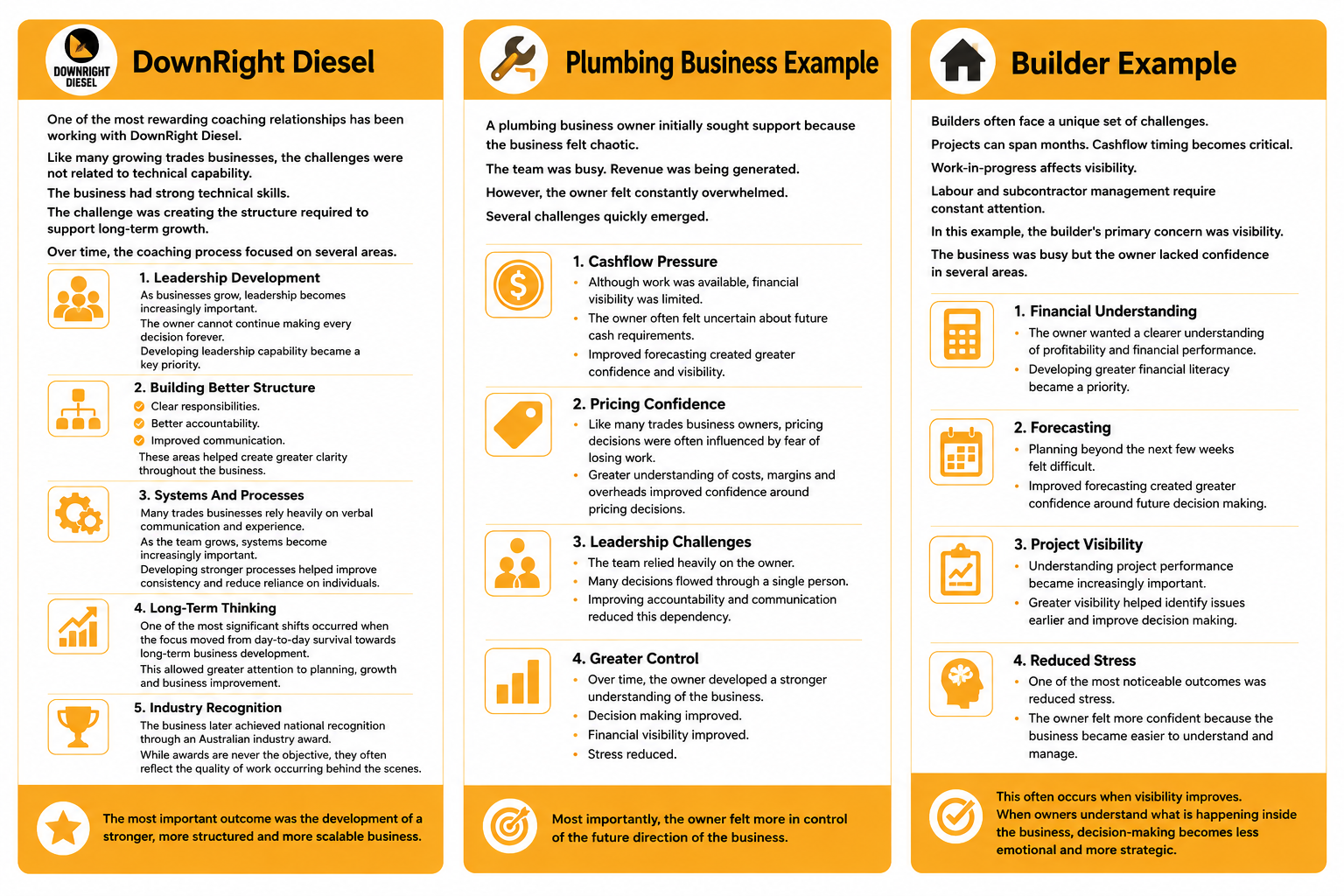
DownRight Diesel
One of the most rewarding coaching relationships has been working with DownRight Diesel.
Like many growing trades businesses, the challenges were not related to technical capability.
The business had strong technical skills.
The challenge was creating the structure required to support long-term growth.
Over time, the coaching process focused on several areas.
Leadership Development
As businesses grow, leadership becomes increasingly important.
The owner cannot continue making every decision forever.
Developing leadership capability became a key priority.
Building Better Structure
Clear responsibilities.
Better accountability.
Improved communication.
These areas helped create greater clarity throughout the business.
Systems And Processes
Many trades businesses rely heavily on verbal communication and experience.
As the team grows, systems become increasingly important.
Developing stronger processes helped improve consistency and reduce reliance on individuals.
Long-Term Thinking
One of the most significant shifts occurred when the focus moved from day-to-day survival towards long-term business development.
This allowed greater attention to planning, growth and business improvement.
Industry Recognition
The business later achieved national recognition through an Australian industry award.
While awards are never the objective, they often reflect the quality of work occurring behind the scenes.
The most important outcome was the development of a stronger, more structured and more scalable business.

Plumbing Business Example
A plumbing business owner initially sought support because the business felt chaotic.
The team was busy.
Revenue was being generated.
However, the owner felt constantly overwhelmed.
Several challenges quickly emerged.
Cashflow Pressure
Although work was available, financial visibility was limited.
The owner often felt uncertain about future cash requirements.
Improved forecasting created greater confidence and visibility.
Pricing Confidence
Like many trades business owners, pricing decisions were often influenced by fear of losing work.
Greater understanding of costs, margins and overheads improved confidence around pricing decisions.
Leadership Challenges
The team relied heavily on the owner.
Many decisions flowed through a single person.
Improving accountability and communication reduced this dependency.
Greater Control
Over time, the owner developed a stronger understanding of the business.
Decision making improved.
Financial visibility improved.
Stress reduced.
Most importantly, the owner felt more in control of the future direction of the business.

Builder Example
Builders often face a unique set of challenges.
Projects can span months.
Cashflow timing becomes critical.
Work-in-progress affects visibility.
Labour and subcontractor management require constant attention.
In this example, the builder's primary concern was visibility.
The business was busy but the owner lacked confidence in several areas.
Financial Understanding
The owner wanted a clearer understanding of profitability and financial performance.
Developing greater financial literacy became a priority.
Forecasting
Planning beyond the next few weeks felt difficult.
Improved forecasting created greater confidence around future decision making.
Project Visibility
Understanding project performance became increasingly important.
Greater visibility helped identify issues earlier and improve decision making.
Reduced Stress
One of the most noticeable outcomes was reduced stress.
The owner felt more confident because the business became easier to understand and manage.
This often occurs when visibility improves.
When owners understand what is happening inside the business, decision-making becomes less emotional and more strategic.

What Results Can Trades Business Coaching Deliver?

Every business is different.
Every owner is different.
For that reason, coaching outcomes will vary.
However, there are several results that commonly emerge when owners consistently apply what they learn.
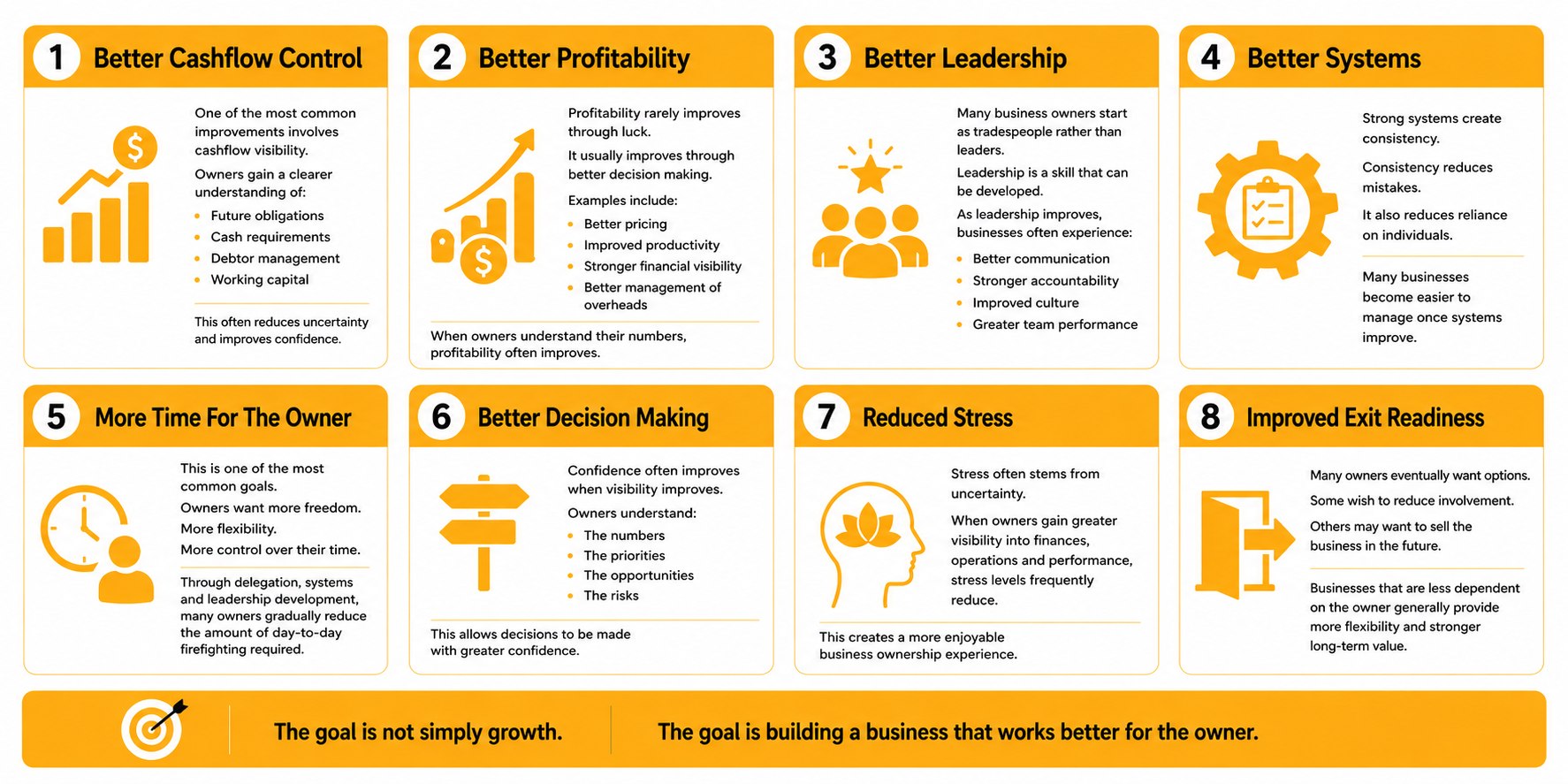
Better Cashflow Control
One of the most common improvements involves cashflow visibility.
Owners gain a clearer understanding of:
Future obligations
Cash requirements
Debtor management
Working capital
This often reduces uncertainty and improves confidence.

Better Profitability
Profitability rarely improves through luck.
It usually improves through better decision making.
Examples include:
Better pricing
Improved productivity
Stronger financial visibility
Better management of overheads
When owners understand their numbers, profitability often improves.

Better Leadership
Many business owners start as tradespeople rather than leaders.
Leadership is a skill that can be developed.
As leadership improves, businesses often experience:
Better communication
Stronger accountability
Improved culture
Greater team performance

Better Systems
Strong systems create consistency.
Consistency reduces mistakes.
It also reduces reliance on individuals.
Many businesses become easier to manage once systems improve.

More Time For The Owner
This is one of the most common goals.
Owners want more freedom.
More flexibility.
More control over their time.
Through delegation, systems and leadership development, many owners gradually reduce the amount of day-to-day firefighting required.

Better Decision Making
Confidence often improves when visibility improves.
Owners understand:
The numbers
The priorities
The opportunities
The risks
This allows decisions to be made with greater confidence.

Reduced Stress
Stress often stems from uncertainty.
When owners gain greater visibility into finances, operations and performance, stress levels frequently reduce.
This creates a more enjoyable business ownership experience.

Improved Exit Readiness
Many owners eventually want options.
Some wish to reduce involvement.
Others may want to sell the business in the future.
Businesses that are less dependent on the owner generally provide more flexibility and stronger long-term value.
The goal is not simply growth.
The goal is building a business that works better for the owner.

Frequently Asked Questions

A Trades Business Coach helps business owners improve the business side of their operation. This often includes profitability, cashflow, pricing, leadership, team performance, structure, systems and business planning. While most trades business owners are highly skilled at their trade, many have never received formal business education. Coaching helps bridge that gap and provides support, accountability and guidance to help owners make better business decisions.

Many owners reach a point where working harder no longer solves the problem. They become trapped inside the business and struggle to gain control of their time, team or finances. A Trades Business Coach provides an external perspective, accountability and practical guidance to help identify issues and implement improvements.

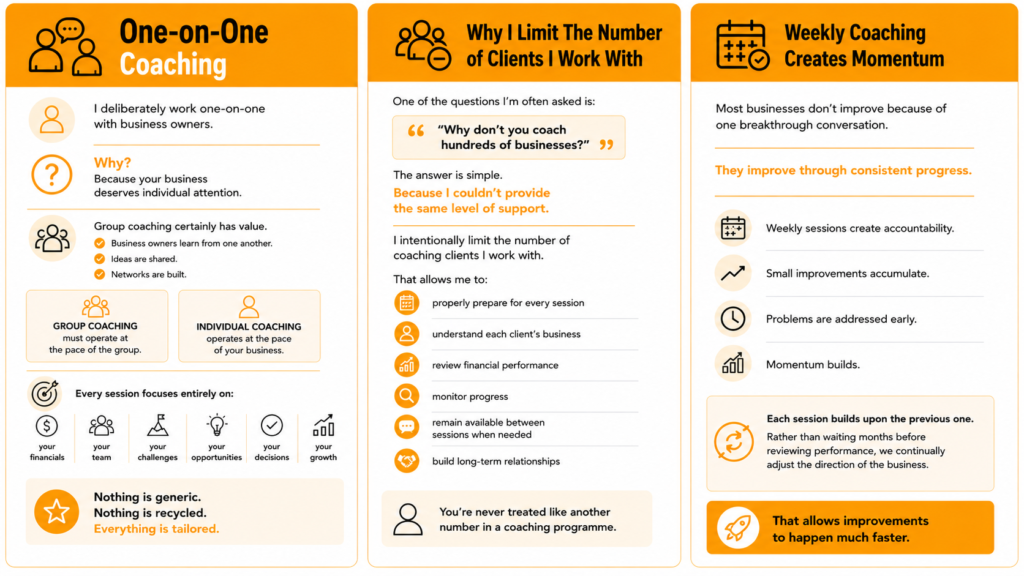
Coaching is tailored to the specific needs of the business. Sessions focus on identifying priorities, solving problems, improving financial understanding, strengthening leadership and implementing practical improvements. Unlike group programs, coaching is personalised to the individual business and owner.

Every business is different. Coaching is tailored to the goals, challenges and stage of development of the business owner. The best way to determine suitability is through a confidential discovery call where we can discuss your business and identify whether BusinessSight is the right fit.

Yes. BusinessSight works with trades businesses throughout Australia using online coaching sessions. This allows business owners to access specialist coaching regardless of location.

Yes. Builders make up a significant portion of the businesses I work with. Common areas of focus include cashflow, forecasting, project visibility, leadership, profitability, structure and reducing owner dependency.

Yes. Plumbing businesses commonly seek support around cashflow management, pricing, team development, leadership, forecasting and business growth.

Yes. Electrical contractors often face challenges involving labour management, profitability, scheduling, team development and operational structure.

Yes. This includes diesel mechanical businesses, maintenance businesses and service-based mechanical operations. Coaching often focuses on profitability, systems, leadership and business growth.

BusinessSight is generally best suited to established trades businesses with four or more team members. Most businesses are looking for greater control, stronger profitability, improved structure and long-term growth.

Yes. Cashflow is one of the most common topics addressed during coaching. This often includes forecasting, debtor management, working capital, progress claims and improving financial visibility.

Yes. Profitability is often influenced by pricing, productivity, financial understanding, overhead management and decision making. Coaching helps owners better understand and improve these areas.

Absolutely. Many trades businesses undercharge because they lack confidence in their numbers or fear losing work. Coaching helps owners understand costs, margins and profitability so pricing decisions can be made with greater confidence.

In many cases, yes. This typically involves improving delegation, developing team capability, building systems and creating stronger business structures that reduce reliance on the owner.

Yes. Leadership development is a common area of focus. Building capable leaders often helps improve accountability, communication and overall business performance.

Many clients report reduced stress as they gain greater visibility into their business. Improved financial understanding, stronger systems and better leadership often create a greater sense of control.

Yes. Systems are critical for consistency and scalability. Coaching often focuses on identifying areas where stronger systems can improve efficiency and reduce owner dependency.

Yes. Most trades business owners start as tradespeople rather than leaders. Leadership development helps owners build stronger teams, improve communication and create better accountability.

Forecasting is one of the most valuable tools available to a business owner. Coaching often includes financial forecasting, cashflow forecasting and resource planning to improve visibility and decision making.

Yes. Financial understanding is a major component of BusinessSight coaching. Owners learn to understand profitability, cashflow, KPIs, forecasting and the financial drivers of business performance.

The first session is focused on understanding your business, your challenges and your goals. It provides an opportunity to identify priorities and establish a plan for moving forward.

Every business is different. Some owners experience immediate clarity and improved decision making, while larger structural improvements may take longer. Sustainable improvement is typically built through consistent implementation over time.

The length of engagement varies. Some businesses require support for a specific challenge, while others choose to continue coaching as they move through different stages of growth and development.

Preparation is generally simple. Owners benefit most when they are willing to be open, honest and committed to implementing agreed actions between sessions.

BusinessSight focuses exclusively on trades businesses. This includes builders, plumbers, electricians, mechanical businesses, maintenance contractors and service-based trade businesses.

Yes. Stronger systems, better leadership, improved financial visibility and reduced owner dependency often contribute to greater business value and improved sale readiness.

This is one of the most common coaching objectives. Through systems, delegation, leadership development and structure, businesses can become less reliant on the owner for day-to-day operations.

Many business challenges originate within projects. Scheduling, labour allocation, communication, variations and project delivery all influence financial outcomes. Experience in project environments helps connect operational issues with business performance.

BusinessSight specialises exclusively in trades businesses. Coaching is delivered one-on-one, focuses on practical implementation and is grounded in both commercial project experience and more than 20 years of coaching trades businesses.

If you feel stuck, overwhelmed, frustrated, uncertain about your numbers or trapped inside your business, coaching may be worth exploring. A discovery call provides an opportunity to discuss your situation and determine whether BusinessSight is a suitable fit.

No. Many business owners seek coaching because they want to improve an already successful business. Coaching is often used to strengthen leadership, improve profitability, prepare for growth or reduce owner dependency.

Yes. Accountability is a common challenge within growing trades businesses. Coaching often focuses on creating clarity around roles, responsibilities, expectations and performance standards.

Yes. Growth is often a goal, but sustainable growth requires structure, systems, leadership and financial visibility. Coaching helps ensure growth does not create unnecessary chaos.

One of the most common mistakes is focusing solely on revenue while neglecting structure, profitability, cashflow and leadership. A bigger business does not automatically create a better business.


Why BusinessSight Is Different

There are thousands of business coaches operating throughout Australia.
Many are highly capable.
However, very few focus exclusively on trades businesses.
Even fewer combine commercial project experience with more than two decades of coaching trade business owners.
This combination is one of the reasons many clients choose BusinessSight.
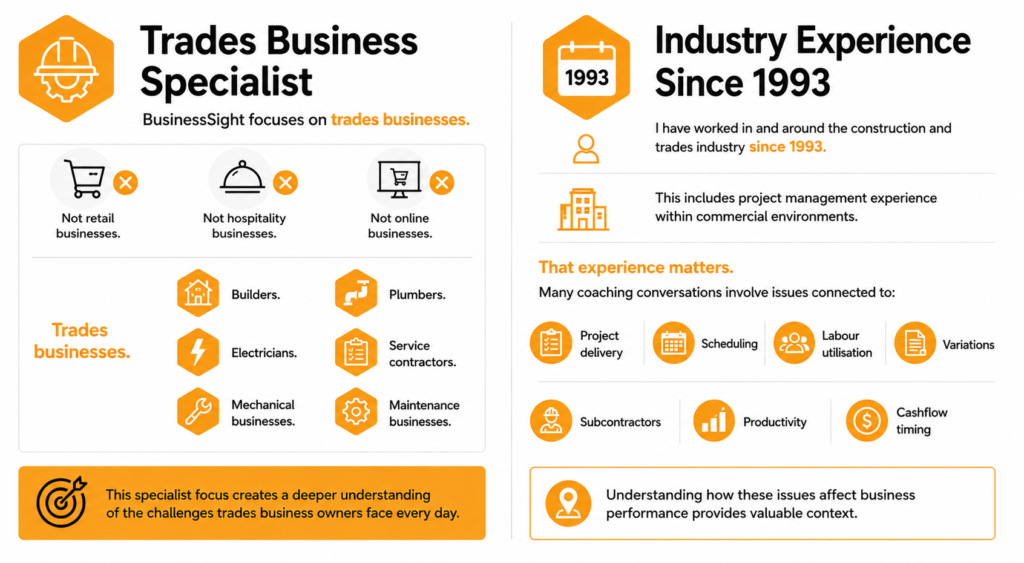
Trades Business Specialist
BusinessSight focuses on trades businesses.
Not retail businesses.
Not hospitality businesses.
Not online businesses.
Trades businesses.
Builders.
Plumbers.
Electricians.
Mechanical businesses.
Service contractors.
Maintenance businesses.
This specialist focus creates a deeper understanding of the challenges trades business owners face every day.

Industry Experience Since 1993
I have worked in and around the construction and trades industry since 1993.
This includes project management experience within commercial environments.
That experience matters.
Many coaching conversations involve issues connected to:
Project delivery
Scheduling
Labour utilisation
Variations
Subcontractors
Productivity
Cashflow timing
Understanding how these issues affect business performance provides valuable context.
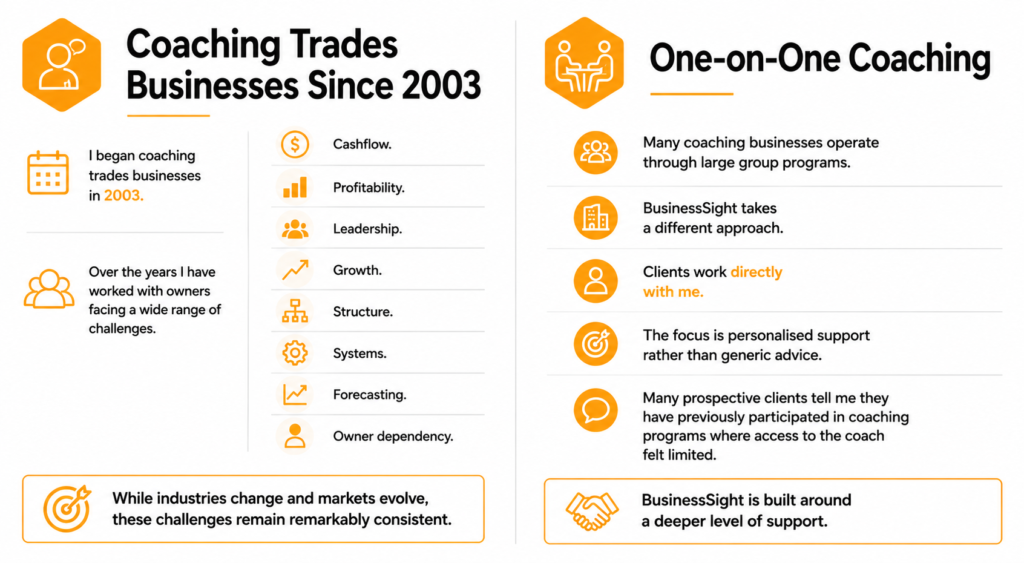
Coaching Trades Businesses Since 2003
I began coaching trades businesses in 2003.
Over the years I have worked with owners facing a wide range of challenges.
Cashflow.
Profitability.
Leadership.
Growth.
Structure.
Systems.
Forecasting.
Owner dependency.
While industries change and markets evolve, these challenges remain remarkably consistent.

One-on-One Coaching
Many coaching businesses operate through large group programs.
BusinessSight takes a different approach.
Clients work directly with me.
The focus is personalised support rather than generic advice.
Many prospective clients tell me they have previously participated in coaching programs where access to the coach felt limited.
BusinessSight is built around a deeper level of support.
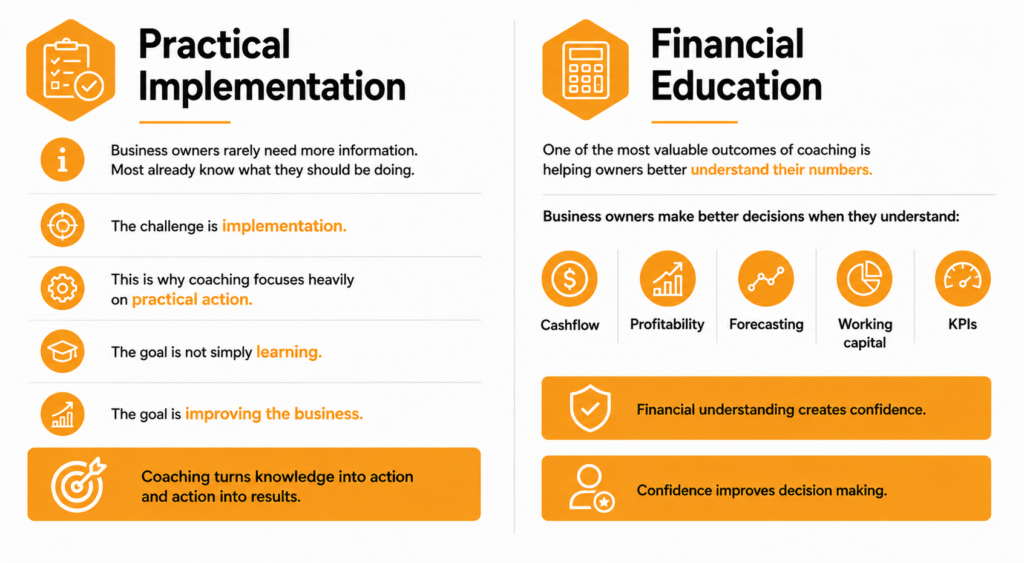
Practical Implementation
Business owners rarely need more information.
Most already know what they should be doing.
The challenge is implementation.
This is why coaching focuses heavily on practical action.
The goal is not simply learning.
The goal is improving the business.

Financial Education
One of the most valuable outcomes of coaching is helping owners better understand their numbers.
Business owners make better decisions when they understand:
Cashflow
Profitability
Forecasting
Working capital
KPIs
Financial understanding creates confidence.
Confidence improves decision making.
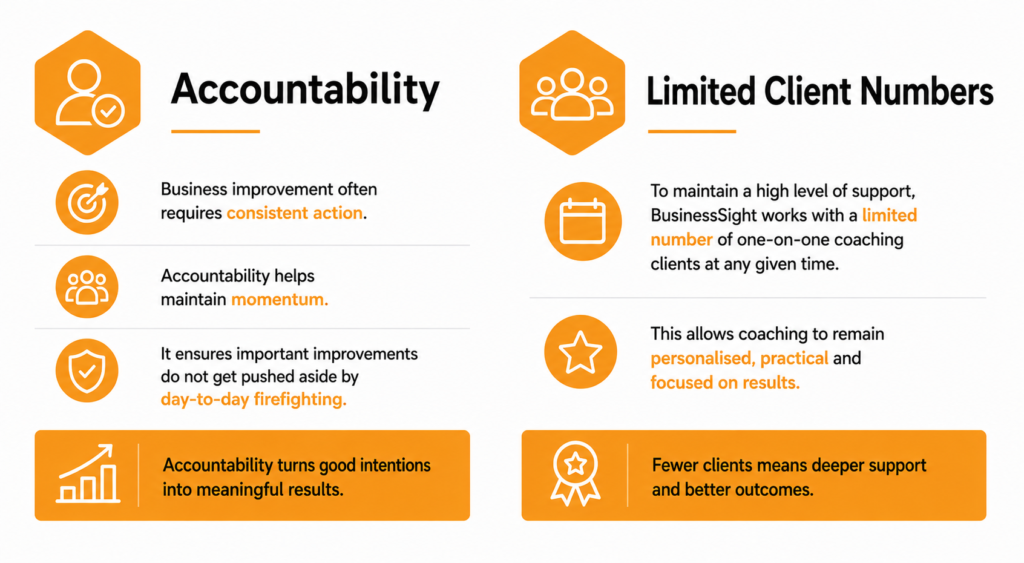
Accountability
Business improvement often requires consistent action.
Accountability helps maintain momentum.
It ensures important improvements do not get pushed aside by day-to-day firefighting.

Limited Client Numbers
To maintain a high level of support, BusinessSight works with a limited number of one-on-one coaching clients at any given time.
This allows coaching to remain personalised, practical and focused on results.

Book a Discovery Call

BusinessSight is not designed for every business.
The ideal client is typically an established trades business owner who wants more than motivation and generic business advice.

Most clients have:
✔︎ Four or more team members
✔︎ A desire to improve profitability
✔︎ A desire to improve cashflow
✔︎ A desire to strengthen leadership
✔︎ A desire to build better systems
✔︎ A desire to reduce owner dependency
✔︎ A desire to gain greater control over the business

Many owners contact me because they are tired of carrying everything themselves.
They want a business that can operate more effectively without constant intervention.
They want better visibility.
Better structure.
Better leadership.
Better financial understanding.
Most importantly, they want a business that supports their life rather than consumes it.
If that sounds familiar, the next step is a confidential discovery call.
The purpose of the call is simple.
Understand your business.
Identify the biggest challenges.
Discuss your goals.
Determine whether BusinessSight is the right fit.
There is no obligation.
No pressure.
Just a practical conversation about where your business is today and where you would like it to be in the future.
If you are looking for a Trades Business Coach Australia specialist who understands both the realities of project environments and the realities of running a trades business, I invite you to book a confidential discovery call.

About Miles Primrose

  • Miles Primrose is the founder of BusinessSight.40+ years in the trades industry
  • He has worked in and around the construction and trades industry since 1993 and has specialised in coaching trades businesses since 2003.
  • Miles works directly with builders, plumbers, electricians, mechanical businesses and service-based trade companies across Australia.
  • His coaching focuses on helping business owners improve profitability, strengthen cashflow, develop leadership capability, build better business structures and reduce owner dependency.
  • BusinessSight provides one-on-one coaching designed specifically for established Australian trades businesses seeking greater control, stronger performance and long-term business success.