
Why Every Decision Comes Through You (And How to Fix It)
Growing Your Trade Business Shouldn’t Mean Working Longer Hours
When you first started your trade business, it made sense that every decision came through you.
You answered the phone.
You quoted the work.
You ordered the materials.
You dealt with customers.
You fixed mistakes.
You solved every problem.
After all, there was only you.
As your business grew and you employed your first apprentice, then another tradesperson, then an office administrator, you probably expected life to become easier.
Instead, something unexpected happened.
Your workload increased.
Now, instead of doing all the work yourself, you’re responsible for everyone else’s work as well.
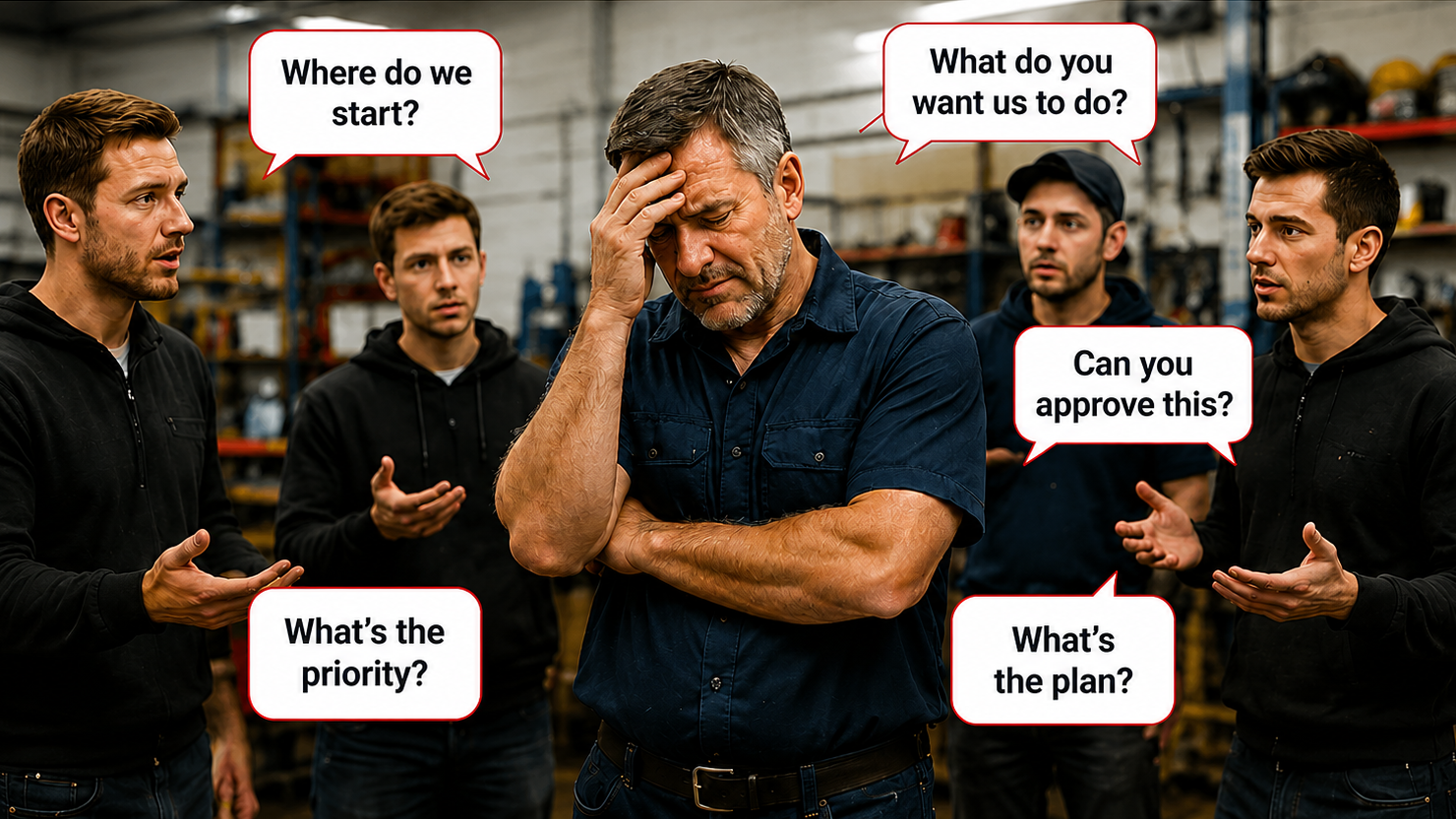
Every phone call still lands on your desk.
Every quote needs your approval.
Every customer issue comes to you.
Your team asks permission before making even small decisions.
Nothing seems to happen unless you’re involved.
If this sounds familiar, you’re not alone.
It’s one of the most common challenges I see when working with trade business owners across Australia.
Many owners believe they have a staffing problem.
Others think they simply need better employees.
In reality, the issue is usually something else entirely.
You’ve become the bottleneck.
The good news?
A bottleneck isn’t caused by having a bad team.
It’s caused by having a business that depends too heavily on one person.
Once you understand why this happens—and how to fix it—you can build a business that continues moving forward even when you’re not making every decision.
What Is a Business Bottleneck?
A bottleneck is exactly what it sounds like.
Imagine an hourglass.
Thousands of grains of sand are trying to pass through a tiny opening.
No matter how much sand is waiting above, only a small amount can move through at any one time.
Your trade business works the same way.
Customers are calling.
Quotes need to go out.
Jobs need scheduling.
Materials need ordering.
Invoices need approving.
Staff need answers.
Suppliers need decisions.
Yet every one of those decisions is waiting for the same person.
You.
The business isn’t limited by demand.
It isn’t limited by marketing.
It isn’t limited by the quality of your tradespeople.
It’s limited by the number of decisions one person can make in a day.
This creates delays, frustration and unnecessary stress throughout the business.
Ironically, the better your business becomes at attracting work, the worse the bottleneck gets unless your systems evolve with it.
Why This Happens in Trade Businesses
Unlike many industries, trades businesses are usually started by people who are exceptional tradespeople.
Electricians.
Plumbers.
Builders.
Carpenters.
HVAC technicians.
Painters.
Roofers.
Landscapers.
The business often grows because the owner is known for doing quality work.
Customers trust them.
Builders request them by name.
Word spreads.
Soon there’s enough work to employ someone else.
At this stage, the owner is still doing nearly everything.
The only difference is they’ve added staff.
The problem is that the business structure hasn’t changed.
The owner is still:
— Chief estimator
— Operations manager
— Sales manager
— Customer service manager
— Financial controller
— HR manager
— Purchasing officer
— Quality controller
— Team leader
Eventually, every department relies on the same person.
Instead of building a business, they’ve unintentionally built a job with more responsibility.
The Success Trap
One of the biggest surprises for many business owners is that success can actually create bigger problems.
Imagine two plumbing businesses.
The first has two staff.
The second has twelve.
Most people assume the second owner has more freedom.
Often, the opposite is true.
The owner of the larger business may receive:
— More phone calls.
— More supplier questions.
— More payroll issues.
— More customer complaints.
— More vehicle breakdowns.
— More pricing approvals.
— More scheduling conflicts.
— More staff needing guidance.
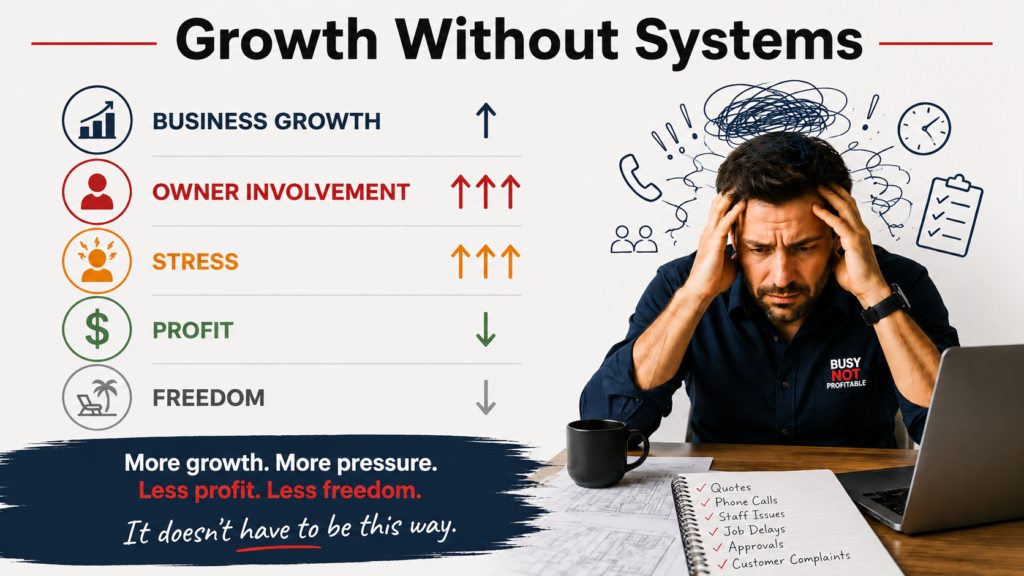
Without systems, growth multiplies complexity.
Many owners respond by working longer hours.
They arrive earlier.
They leave later.
They answer emails at night.
They answer calls on weekends.
They become available 24 hours a day.
For a while, the business keeps growing.
Eventually, however, the owner reaches capacity.
Growth slows.
Not because there isn’t enough work.
Because there isn’t enough owner.
The Real Cost of Being the Bottleneck
Most owners think the biggest cost is stress.
Stress is certainly part of it.
But it’s only the beginning.
1. Slower Decisions
When staff have to wait for approval, jobs slow down.
Customers wait longer.
Suppliers wait longer.
Office staff wait longer.
Nothing moves until you’re available.
That delay compounds across dozens of decisions every day.
2. Lower Productivity
Imagine a tradesperson standing around for fifteen minutes waiting for an answer.
It doesn’t sound significant.
Now multiply that across:
— six employees
— three times per day
— five days per week
Hundreds of productive hours disappear every year.
3. Frustrated Employees
Good employees enjoy responsibility.
Talented people want to solve problems.
When every decision is taken away from them, they stop thinking independently.
Eventually they begin asking permission for everything because that’s what they’ve been conditioned to do.
Owners then complain:
“Nobody uses initiative anymore.”
The reality?
Many businesses accidentally train initiative out of their team.
4. Customers Feel the Delay
Customers don’t usually know why something is delayed.
They simply notice that:
— nobody calls back
— quotes take too long
— decisions take days
— variations aren’t approved
— problems aren’t solved quickly
From the customer’s perspective, the business appears disorganised.
5. The Owner Never Switches Off
One of the biggest reasons people start a business is to gain more freedom.
Instead, many trade business owners become permanently connected to work.
The phone sits beside the bed.
Family dinners are interrupted.
Holidays involve answering calls.
Even when physically away from work, mentally they’re still at work.
Over time, this constant decision-making becomes exhausting.
Decision Fatigue Is Real
Every day you make hundreds of decisions.
Should we discount this quote?
Can we fit this customer in tomorrow?
Do we replace the vehicle?
Should we order another pallet?
Do I approve this leave request?
Can this apprentice attend training?
Should we chase this debtor?
Should I answer that email now?
Individually, none of these decisions are particularly difficult.
Collectively, they’re draining.
Researchers refer to this as decision fatigue.
The more decisions you make, the harder it becomes to consistently make good ones.
This is why many owners find themselves making poorer decisions late in the afternoon than they would have made at 8:00 am.
It’s not because they’ve become worse leaders.
It’s because they’re carrying too much mental load.
The solution isn’t simply working harder.
It’s reducing the number of decisions that only you can make.
Here’s the Question Every Trade Business Owner Should Ask
Instead of asking:
“How can I work harder?”
Ask yourself:
“Why does this decision require me in the first place?”
That single question changes everything.
Sometimes you’ll discover the answer is:
“We’ve never written a process.”
Other times:
“My team has never been trained.”
Or perhaps:
“I’ve never actually given them permission to decide.”
Those insights become the foundation for building a business that doesn’t depend on you every minute of every day.
You’re Probably More Capable Than Your Business Structure
One of the biggest misconceptions among successful trade business owners is believing they’re the problem.
They’re not.
Most owners are highly capable.
They’ve built a strong reputation, won loyal customers and grown a team through years of hard work.
The issue is that the business has grown faster than its systems.
You’ve outgrown the structure that once worked.
That’s actually a good sign.
It means the business is ready for the next stage of growth.
But getting there requires a shift—from being the person who makes every decision to becoming the person who builds a business capable of making good decisions without you.
That transition doesn’t happen overnight, but it starts with recognising that being indispensable isn’t the goal.
Building a business that performs exceptionally well because of your leadership—not your constant involvement—is.
Are You the Bottleneck? Seven Warning Signs to Look For
Most trade business owners don’t wake up one morning and decide they want every decision to come through them.
It happens gradually.
In fact, many owners don’t realise they’ve become the bottleneck until they take a holiday, become sick or try to step away from the business for a few days.
That’s when the phone starts ringing.
“Where’s the key?”
“Can we order this?”
“What should I charge?”
“The customer wants to change the scope.”
“Can you just quickly approve this?”
If your business can’t confidently answer these questions without you, it’s worth asking whether the issue is your team—or whether the business has become too dependent on one person.
Here are seven warning signs.
1. Your Phone Never Stops Ringing
Your phone isn’t just a communication tool.
It’s become the control centre for your entire business.
Throughout the day you’re answering calls from:
— Customers.
— Office staff.
— Tradespeople.
— Apprentices.
— Suppliers.
— Accountants.
— Builders.
— Subcontractors.
Every call might only take a few minutes, but together they constantly interrupt your focus.
Research consistently shows that once we’re interrupted, it can take significant time to regain concentration.
That means a two-minute phone call often costs much more than two minutes of productive work.
The problem isn’t that people contact you.
The problem is that they have no one else to contact.
2. Your Team Waits for Permission
One of the clearest signs of an owner-dependent business is a team that constantly seeks approval.
Questions like:
“Can I leave early?”
“Should I order this?”
“Can we fit this customer in?”
“Can I offer a discount?”
“What should I tell the client?”
None of these are difficult decisions.
But when they’re repeated dozens of times every week, they consume hours of your time.
More importantly, they prevent your team from developing judgement and confidence.
Every time you make another small decision for someone else, you reinforce the belief that they shouldn’t make it themselves.
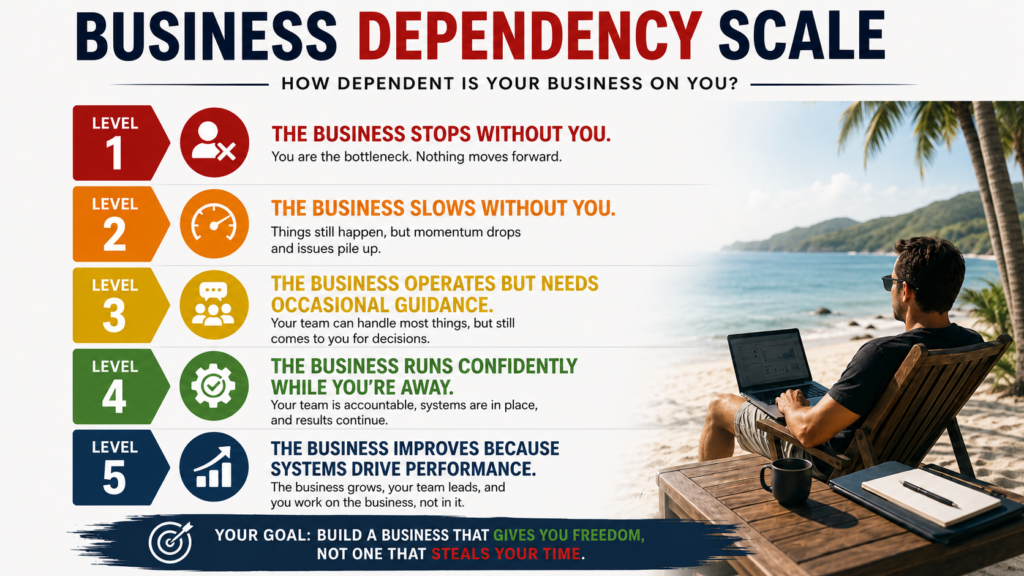
3. Nothing Happens When You’re Away
Imagine taking two weeks off.
Would the business continue operating?
Or would everything slow down until you returned?
Many owners discover the answer the hard way.
Quotes pile up.
Invoices wait.
Customers become frustrated.
Projects stall.
Team members hesitate because they don’t want to make the wrong decision.
Ironically, the owner often returns from holiday more exhausted than when they left because they’re faced with a mountain of work that accumulated while they were away.
A healthy business should continue moving forward even when the owner isn’t physically present.
4. Your Staff Know the Answer—but Still Ask You
This is one of the most frustrating situations for many owners.
You’ve answered the same question countless times.
Your estimator already knows the margin.
Your office manager understands the invoicing process.
Your supervisor has handled similar customer issues before.
Yet they still ask.
Why?
Often, it’s because you’ve unintentionally trained them to.
If every important decision has always been confirmed by you, asking becomes the safest option.
Nobody wants to be criticised for making the wrong call.
Over time, it’s easier to ask than to think.
The goal isn’t to stop questions altogether.
The goal is to create clarity around which decisions require your involvement and which don’t.
5. You Solve Problems Faster Than You Build Capability
Many trade business owners pride themselves on being problem solvers.
It’s one of the reasons they built successful businesses.
When something goes wrong, they jump in immediately.
The customer is looked after.
The issue is resolved.
Everyone moves on.
The problem?
The team hasn’t learned anything.
The next time a similar issue occurs, they come back to you again.
Instead of solving today’s problem, ask yourself:
“How can I ensure this doesn’t require me next time?”
Sometimes the answer is training.
Sometimes it’s documenting a process.
Sometimes it’s giving your team clear decision-making guidelines.
Building capability takes longer today, but it saves countless hours in the future.
6. You Feel Guilty Delegating
Many owners struggle with delegation because they believe it’s quicker to do the job themselves.
And in the short term, they’re often right.
Explaining a task.
Training someone.
Reviewing their work.
Answering follow-up questions.
Initially, this takes longer than simply doing it yourself.
But here’s the trap.
If you keep choosing the quickest option today, you’ll create the busiest version of your future.
Delegation is an investment.
Like any investment, there’s an upfront cost.
The return comes later.
7. You’re Working Harder Than You Did Five Years Ago
One of the biggest warning signs isn’t the number of employees you have.
It’s the number of hours you’re working.
Many trade business owners expected that growing their business would eventually give them more flexibility.
Instead, they find themselves:
— Starting earlier.
— Finishing later.
— Working weekends.
— Answering calls after hours.
— Taking laptops on holidays.
— Thinking about work constantly.
Growth without systems often creates a business that’s larger—but not necessarily better.
A successful business shouldn’t rely on the owner sacrificing more of their personal life each year.
Why Delegation Alone Doesn’t Solve the Problem
When owners realise they’re overwhelmed, the first piece of advice they often receive is:
“You just need to delegate more.”
While well intentioned, this advice is incomplete.
Delegation without structure usually creates frustration for everyone involved.
Imagine telling a new supervisor:
“You’re in charge now.”
Sounds simple.
But what decisions are they allowed to make?
What budget can they approve?
When should they escalate an issue?
What happens if a customer wants to change the scope?
Without clear expectations, delegation simply transfers uncertainty from one person to another.
The supervisor still ends up asking you because they don’t know where the boundaries are.
True delegation isn’t about giving someone more work.
It’s about giving them the authority, knowledge and confidence to make good decisions.
Delegation vs Systems
This is one of the most important distinctions growing trade businesses need to understand.
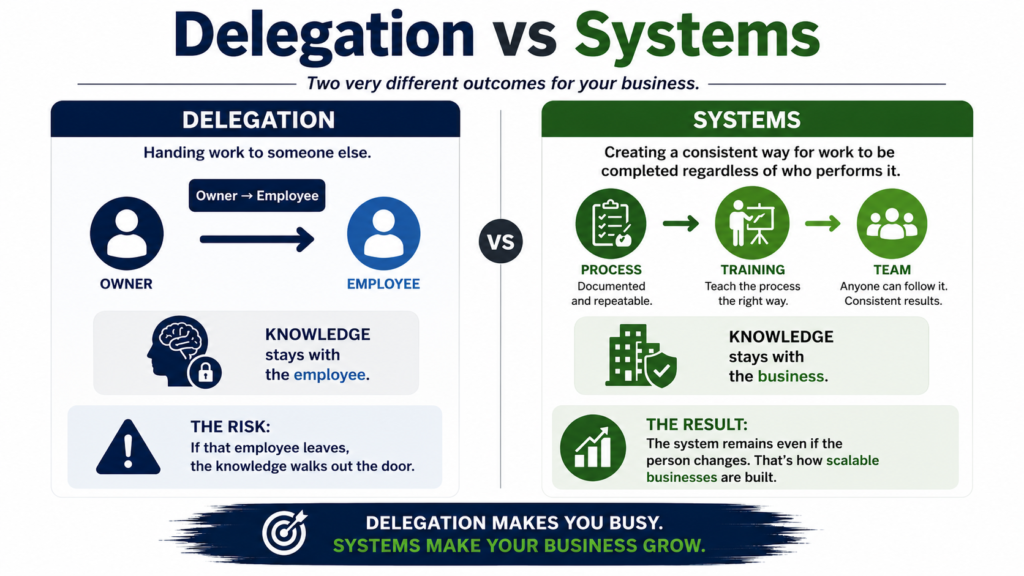
Delegation means handing work to someone else.
Systems mean creating a consistent way for that work to be completed regardless of who performs it.
For example:
A delegated quoting process relies on one estimator.
A systemised quoting process ensures every estimator follows the same pricing framework, uses the same templates and understands the same approval limits.
The system remains even if the person changes.
That’s how scalable businesses are built.
The Hidden Financial Cost of Owner Dependency
Many owners think being involved in everything protects profitability.
In reality, it often reduces it.
Here’s why.
Quotes Take Longer
A customer requests a quote on Monday.
Your estimator prepares it by lunchtime.
They need your approval.
You’re busy on site.
The quote goes out Wednesday afternoon.
Meanwhile, another contractor submitted theirs Monday afternoon.
Who do you think gets the first opportunity?
Speed matters.
Opportunities Are Missed
Because you’re tied up solving operational problems, you’re not focusing on:
— Building relationships.
— Marketing.
— Recruiting quality people.
— Reviewing financial performance.
— Improving pricing.
— Developing future leaders.
These are the activities that create long-term growth.
Unfortunately, they’re often pushed aside because urgent operational issues consume every day.
Payroll Keeps Growing
This surprises many owners.
When staff spend time waiting for decisions, productivity falls.
Lower productivity means fewer billable hours are produced.
To maintain output, businesses often hire more people.
Instead of solving the underlying issue, they increase wages.
The business becomes larger, but not necessarily more profitable.
Your Most Valuable Time Is Spent on Low-Value Decisions
Think about your average day.
How much time do you spend:
— Approving small purchases?
— Answering routine questions?
— Confirming appointment times?
— Solving minor customer issues?
— Checking work that should already have been checked?
Now compare that to the activities only you can do:
— Setting the vision.
— Improving profit margins.
— Building leadership.
— Creating strategic partnerships.
— Developing new services.
— Coaching key team members.
As your business grows, your role should shift from operator to leader.
That doesn’t mean becoming disconnected from the business.
It means spending more of your time on decisions that genuinely require your experience.
The Goal Isn’t to Remove Yourself Completely
Some business advice suggests the owner should never be involved in day-to-day operations.
For most trade businesses, that’s neither realistic nor desirable.
Your experience is one of the business’s greatest assets.
Customers value it.
Your team benefits from it.
The goal isn’t to disappear.
The goal is to be involved where your contribution creates the greatest value—not where you’re simply acting as a human approval stamp.
When every decision requires your input, you’re limiting the growth of both your business and your people.
Strong leaders don’t create followers.
They create more leaders.
The Five Systems That Stop Everything Coming Through You
One of the biggest myths in business is that successful owners simply have better staff.
In my experience coaching trades businesses for more than 23 years, that’s rarely the difference.
The businesses that continue growing aren’t successful because they employ extraordinary people.
They’re successful because ordinary, capable people work within extraordinary systems.
When expectations are clear, responsibilities are defined and decision-making has structure, people become more confident.
The goal isn’t to remove yourself from the business.
It’s to remove yourself from decisions that shouldn’t require your experience.
Here are the five systems every growing trade business should build.
System 1: Decision Boundaries
Most employees aren’t afraid of making decisions.
They’re afraid of making the wrong decision.
That’s an important distinction.
Imagine your office manager receives a request from a customer to move an installation by two days.
Should they approve it?
Maybe.
Maybe not.
If nobody has explained what they’re authorised to decide, the safest option is to ask you.
Instead of expecting people to “use initiative,” define the boundaries.
For example:
Office Manager
— Can approve credits up to $250.
— Can reschedule jobs within the same week.
— Can approve standard leave requests.
— Escalates contractual disputes.
Site Supervisor
— Can purchase materials up to $1,000.
— Can authorise overtime within agreed limits.
— Can resolve standard customer concerns on site.
— Escalates variations above a set dollar value.
The clearer the boundaries, the fewer unnecessary interruptions.
System 2: Standard Operating Procedures (SOPs)
If someone asks the same question twice, it probably needs a documented process.
That doesn’t mean creating a 100-page operations manual that nobody reads.
It means documenting the tasks that happen repeatedly.
Examples include:
— New customer enquiries.
— Quoting process.
— Ordering materials.
— Vehicle maintenance.
— Toolbox meetings.
— Job handovers.
— Variations.
— Final invoices.
— Warranty claims.
— Customer complaints.
Simple checklists often outperform lengthy manuals because they’re practical and easy to follow.
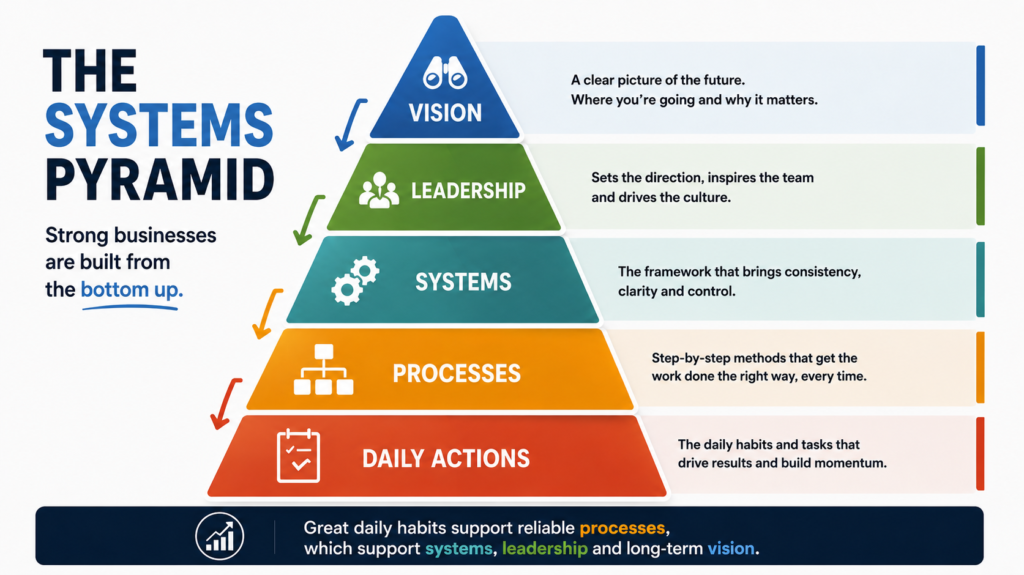
Strong businesses are built from the bottom up. Great daily habits support reliable processes, which support systems, leadership and long-term vision.
System 3: Leadership at Every Level
Many owners believe leadership starts when someone becomes a manager.
In reality, leadership begins much earlier.
An apprentice can demonstrate leadership.
A tradesperson can demonstrate leadership.
An administrator can demonstrate leadership.
Leadership is about taking ownership.
As your business grows, ask yourself:
Who can solve this without me?
Who could solve this with a little coaching?
Who could eventually coach someone else?
Every time you help someone develop judgement instead of simply giving them the answer, your business becomes stronger.
System 4: Visible Numbers
People perform better when they understand what success looks like.
Instead of managing through constant conversations, manage through measurable outcomes.
Examples include:
— Quotes completed within 48 hours.
— Debtor days below target.
— Gross profit percentage.
— Labour recovery.
— Customer satisfaction.
— Callbacks.
— Jobs completed on schedule.
— Revenue per team member.
When everyone understands the scoreboard, fewer conversations are needed.
The numbers become the coach.
System 5: Weekly Leadership Meetings
Many businesses operate entirely in reaction mode.
Problems arise.
People solve them.
Another problem appears.
Nothing changes.
A structured weekly leadership meeting creates space to work on the business rather than simply in it.
A simple agenda might include:
— Safety.
— Customer feedback.
— Financial performance.
— Outstanding quotes.
— Staffing.
— Upcoming workload.
— Challenges.
— Opportunities.
— Decisions required.
Even thirty to sixty minutes each week can dramatically improve communication and reduce daily interruptions.
The Decision Matrix
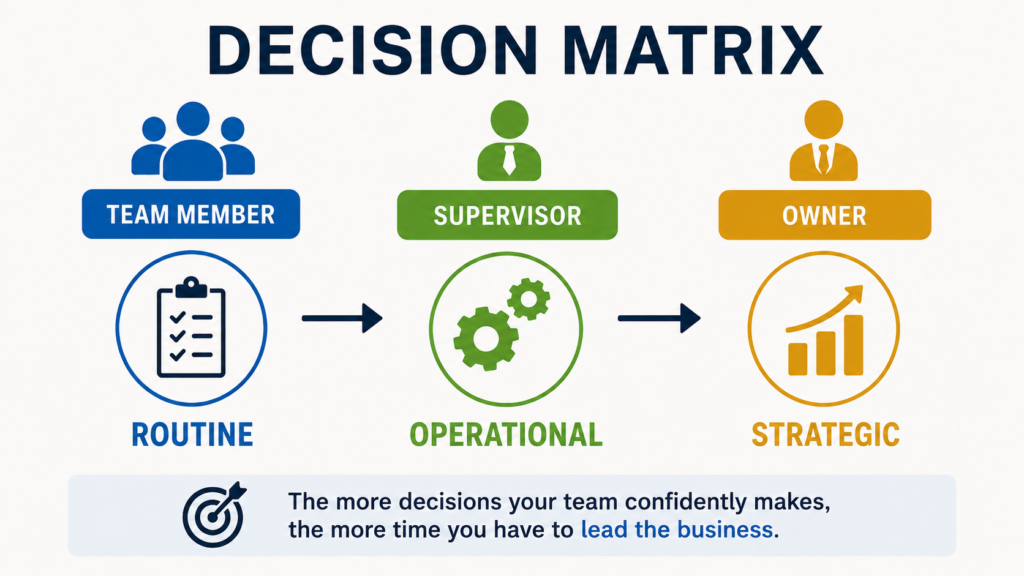
One of the simplest ways to reduce owner dependency is to categorise decisions.
Ask yourself:
Who is the best person to make this decision?
Level 1 – Team Member
Routine decisions that follow established procedures.
Examples:
— Scheduling adjustments.
— Standard material orders.
— Customer updates.
— Booking inspections.
Level 2 – Supervisor
Operational decisions affecting jobs and people.
Examples:
— Labour allocation.
— Minor customer issues.
— Supplier coordination.
— Site changes.
Level 3 – Owner
Strategic decisions.
Examples:
— Hiring senior staff.
— Pricing strategy.
— Purchasing major equipment.
— Business direction.
— Partnerships.
— Capital expenditure.
When owners continue making Level 1 decisions, they’re preventing themselves from focusing on Level 3 decisions that actually grow the business.
A Practical Example
One trades business owner I worked with believed he needed to answer every customer question personally.
His reasoning seemed logical.
“I know the customer best.”
“I don’t want mistakes.”
“I can answer quicker.”
Initially, that worked.
As the business grew beyond ten staff, the volume became overwhelming.
Customers waited.
Staff waited.
The owner worked longer hours.
Instead of telling him to delegate more, we reviewed every recurring question the office received.
Many of the answers were almost identical.
Together, we developed clear procedures, defined approval limits and trained the team using real scenarios.
Within a few months:
— Quotes were going out faster.
— Customers received quicker responses.
— Staff became more confident.
— The owner had time to focus on pricing, recruitment and business growth.
Nothing changed because the owner became less capable.
Your 30-Day Action Plan
You don’t need to rebuild your entire business overnight.
Small improvements, consistently applied, create significant results over time.
Week 1
Keep a notebook beside you.
Every time someone asks you a question, write it down.
At the end of the week, identify the questions that came up more than once.
Those recurring questions reveal where systems are missing.
Week 2
Choose the five most common questions.
Create a simple written process for each one.
Remember, clarity beats complexity.
Week 3
Train your team using those processes.
Don’t simply hand them a document.
Walk through real examples.
Encourage questions.
Build confidence.
Week 4
Introduce decision boundaries.
Explain which decisions each role can make independently.
Support your team as they begin taking greater ownership.
Review progress at the end of the week and adjust where needed.
The Biggest Mindset Shift
Many owners believe their value comes from solving every problem.
The opposite is often true.
Your greatest value comes from building a business that solves problems consistently, even when you’re not present.
That’s what creates freedom.
That’s what improves customer service.
That’s what develops leaders.
And that’s what allows a trade business to continue growing without relying on one person to make every decision.
Frequently Asked Questions
Why does every employee ask me before making a decision?
Usually because decision boundaries haven’t been clearly defined. People naturally seek certainty when they’re unsure of their authority.
What is an owner-dependent business?
It’s a business where important operational decisions rely heavily on the owner rather than documented systems or trained team members.
Can delegation improve profitability?
Yes, when supported by clear systems. Delegation without structure often creates confusion, while structured delegation improves efficiency and productivity.
How do I know if I’m the bottleneck?
If work regularly stops while waiting for your approval, your business has become overly dependent on you.
Why do trade businesses struggle to scale?
Many grow their workload faster than they grow their systems, leadership and processes.
Is it normal for staff to ask lots of questions?
Yes, particularly when they’re new. The goal is for repeated questions to become documented processes over time.
Should every quote require owner approval?
Not necessarily. Many businesses establish approval limits based on quote value, margin or customer type.
What’s the difference between delegation and accountability?
Delegation transfers responsibility for completing a task. Accountability ensures someone remains responsible for the outcome.
Can systems reduce customer complaints?
Absolutely. Consistent processes lead to more consistent customer experiences.
Do small trade businesses need systems?
Yes. In fact, building systems early makes future growth significantly easier.
When should I hire a supervisor?
Generally, when you’re spending more time coordinating work than improving the business.
Why do good employees leave owner-dependent businesses?
Talented people enjoy responsibility and growth. Constantly seeking approval can become frustrating and limit their development.
How do I encourage initiative?
Provide clear expectations, authority and constructive feedback. Initiative grows when people know where the boundaries are.
How often should systems be reviewed?
Review them regularly—especially after recurring problems, business growth or changes in technology.
Can better systems improve cash flow?
Yes. Faster quoting, better scheduling and clearer invoicing all contribute to healthier cash flow.
Should every business have weekly leadership meetings?
In most growing trade businesses, yes. They improve communication, reduce reactive decision-making and keep everyone aligned.
Is this relevant if I’m still on the tools?
Absolutely. Building simple systems while your business is small makes it much easier to step off the tools later.
What’s the first system I should build?
Start with the process that generates the most interruptions. That’s usually where you’ll see the quickest return.
Final Thoughts
If you’ve recognised yourself in this article, don’t be discouraged.
Almost every successful trade business owner goes through this stage.
The fact that everything comes through you doesn’t mean you’ve built a bad business.
It usually means you’ve built a business that’s ready for its next level of growth.
The challenge isn’t finding better employees.
It’s creating the structure, systems and leadership that allow good people to make good decisions confidently.
When that happens, your business becomes faster.
Your team becomes stronger.
Your customers receive a better experience.
And you finally gain the time to focus on the work that only you can do.
Growth shouldn’t require you to work longer hours every year.
With the right systems in place, your business can continue growing while becoming more enjoyable to lead.
Ready to Build a Business That Doesn’t Depend on You?
If every decision still comes through you, it may be time to stop working harder and start building a better business structure.
At BusinessSight, I work one-on-one with established Australian trade business owners to improve leadership, financial performance, systems and accountability.
Together, we’ll identify the bottlenecks holding your business back and put practical strategies in place so your team can take greater ownership and your business can continue growing with confidence.
Miles’ Perspective
Having worked on commercial construction projects and coached trades businesses for over 20 years, I often see businesses become harder to run as they grow because the structure hasn’t evolved with the business.